Showing posts with label 2016 housing market. Show all posts

Wednesday, December 21, 2016

#1 is a different approach to selling a home, that works. #2 is where I come into the picture...

2 Tips to Ensure You Get the Most Money When Selling Your House

2 Tips to Ensure You Get the Most Money When Selling Your House | MyKCM
Every homeowner wants to make sure they get the best price when selling their home. But how do you guarantee that you receive maximum value for your house? Here are two keys to ensuring you get the highest price possible.
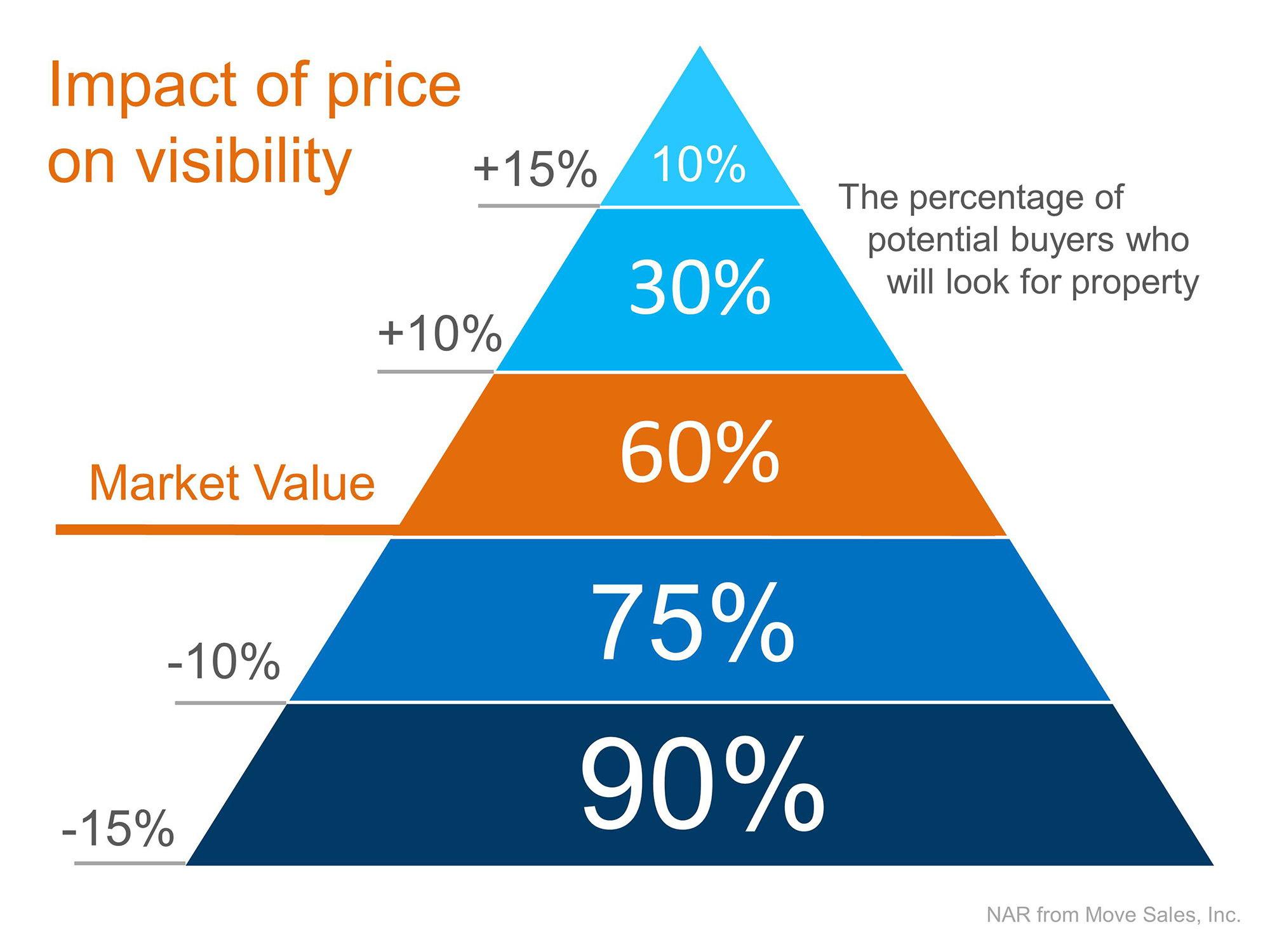
1. Price it a LITTLE LOW 

This may seem counterintuitive. However, let’s look at this concept for a moment. Many homeowners think that pricing their home a little OVER market value will leave them room for negotiation. In actuality, this just dramatically lessens the demand for your house (see chart below).
2 Tips to Ensure You Get the Most Money When Selling Your House | MyKCM
Instead of the seller trying to ‘win’ the negotiation with one buyer, they should price it so that demand for the home is maximized. By doing this, the seller will not be fighting with a buyer over the price, but will instead have multiple buyers fighting with each other over the house.
Realtor.com, gives this advice:
“Aim to price your property at or just slightly below the going rate. Today’s buyers are highly informed, so if they sense they’re getting a deal, they’re likely to bid up a property that’s slightly underpriced, especially in areas with low inventory.”

2. Use a Real Estate Professional

This too may seem counterintuitive. The seller may think they would net more money if they didn’t have to pay a real estate commission. With that being said, studies have shown that homes typically sell for more money when handled by a real estate professional.
Research posted by the National Association of Realtors revealed that:
“The median selling price for all FSBO homes was $185,000 last year. When the buyer knew the seller in FSBO sales, the number sinks to the median selling price of $163,800. However, homes that were sold with the assistance of an agent had a median selling price of $245,000 – nearly $60,000 more for the typical home sale.”


Bottom Line

Price your house at or slightly below the current market value and hire a professional. That will guarantee you maximize the price you get for your house.

Monday, December 19, 2016

Today's temperature may make this argument a bit less convincing ;)

Why You Shouldn’t Take Your House Off the Market During the Holidays

https://goo.gl/QWXa3p
If you are one of the many homeowners who is debating taking your home off the market for the next few weeks, don’t! You will miss the great opportunity you have right now!
The latest Existing Home Sales Report from The National Association of Realtors (NAR), revealed that the inventory of homes for sale has dropped to a 4.3-month supply.
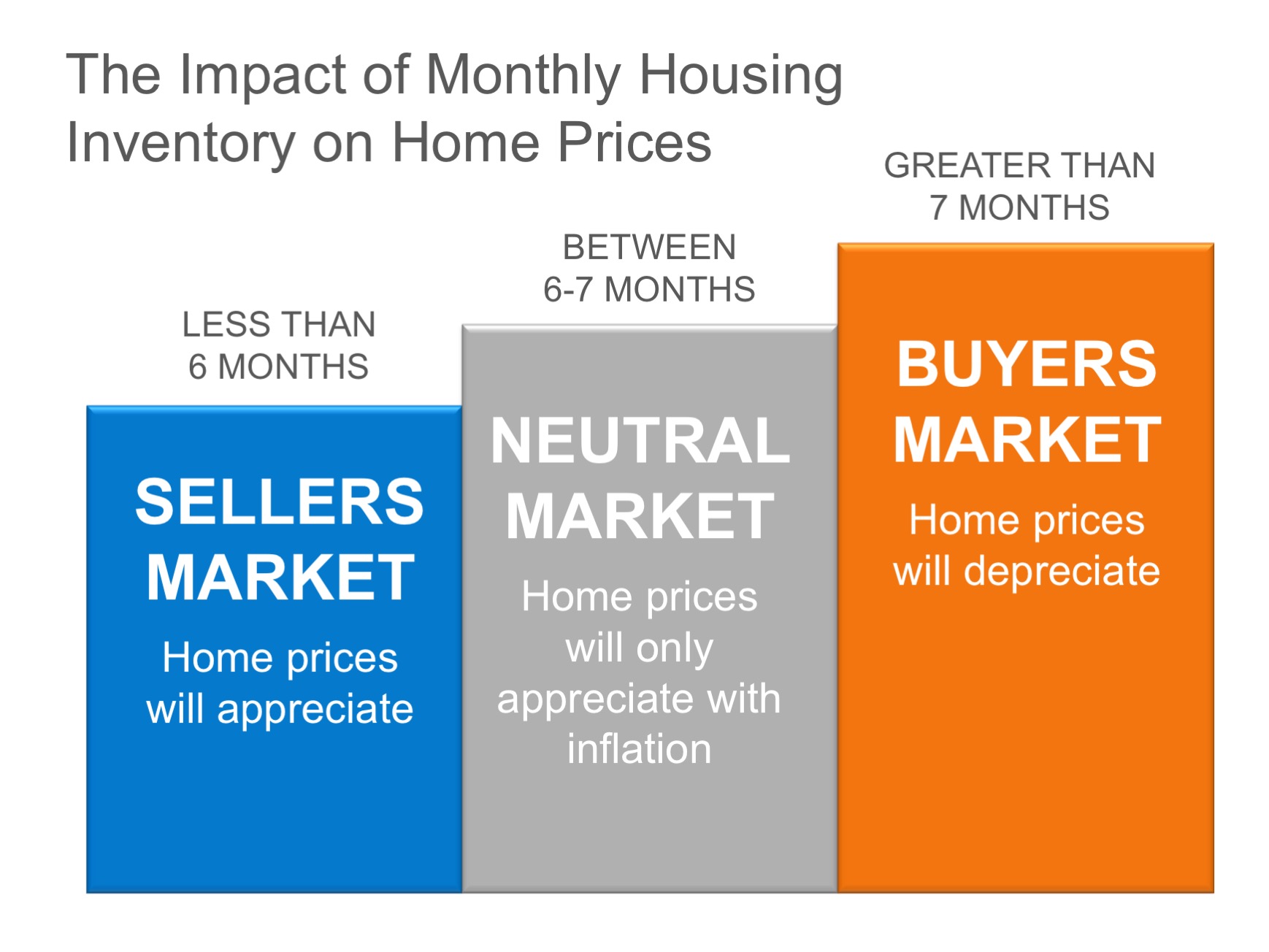
Historically, a 6-month supply is necessary for a ‘normal’ market, explained below:
Why You Shouldn’t Take Your House Off the Market During the Holidays | MyKCM
There are more buyers that are ready, willing, and able to buy now than there have been in years! The supply of homes for sale is not keeping up with the demand of these buyers.

Bottom Line

Home prices are appreciating in this seller’s market. Making your home available over the next few weeks will give you the most exposure to buyers who will be competing against each other to buy it.

Thursday, December 15, 2016

While past activity is not a guarantee of future action, it can provide some insight into what lies ahead. Thinking of selling in the spring? The graph is a pretty convincing reason to list sooner than later...


The #1 Reason to Sell Now… Not Next Spring


The #1 Reason to Sell Now… Not Next Spring | MyKCM
The price of any item (including residential real estate) is determined by ‘supply and demand’. If many people are looking to buy an item and the supply of that item is limited, the price of that item increases.
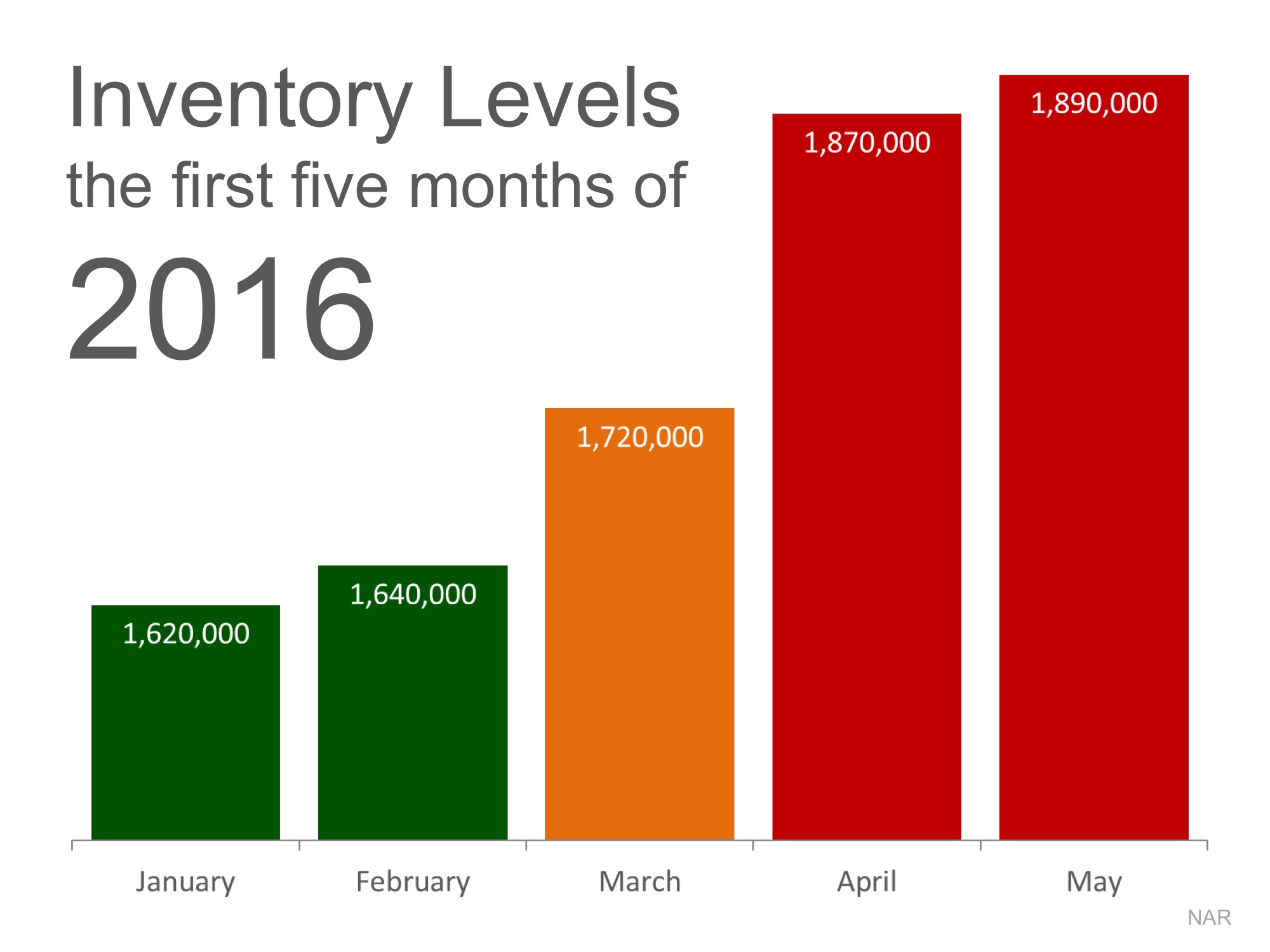
According to the National Association of Realtors (NAR), the supply of homes for sale dramatically increases every spring. As an example, here is what happened to housing inventory at the beginning of 2016:
The #1 Reason to Sell Now… Not Next Spring | MyKCM
Putting your home on the market now instead of waiting for increased competition in the spring might make a lot of sense.

Bottom Line

Buyers in the market during the winter months are truly motivated purchasers. They want to buy now. With limited inventory currently available in most markets, sellers are in a great position to negotiate.

Tuesday, December 13, 2016

Analysts project significant appreciation in the housing market, over the next 5 years...

Home Prices: Where Will They Be in 5 Years?

Home Prices: Where Will They Be in 5 Years? | MyKCM
Today, many real estate conversations center on housing prices and where they may be headed. That is why we like the Home Price Expectation Survey.
Every quarter, Pulsenomics surveys a nationwide panel of over one hundred economists, real estate experts, and investment & market strategists about where they believe prices are headed over the next five years. They then average the projections of all 100+ experts into a single number.

The results of their latest survey:

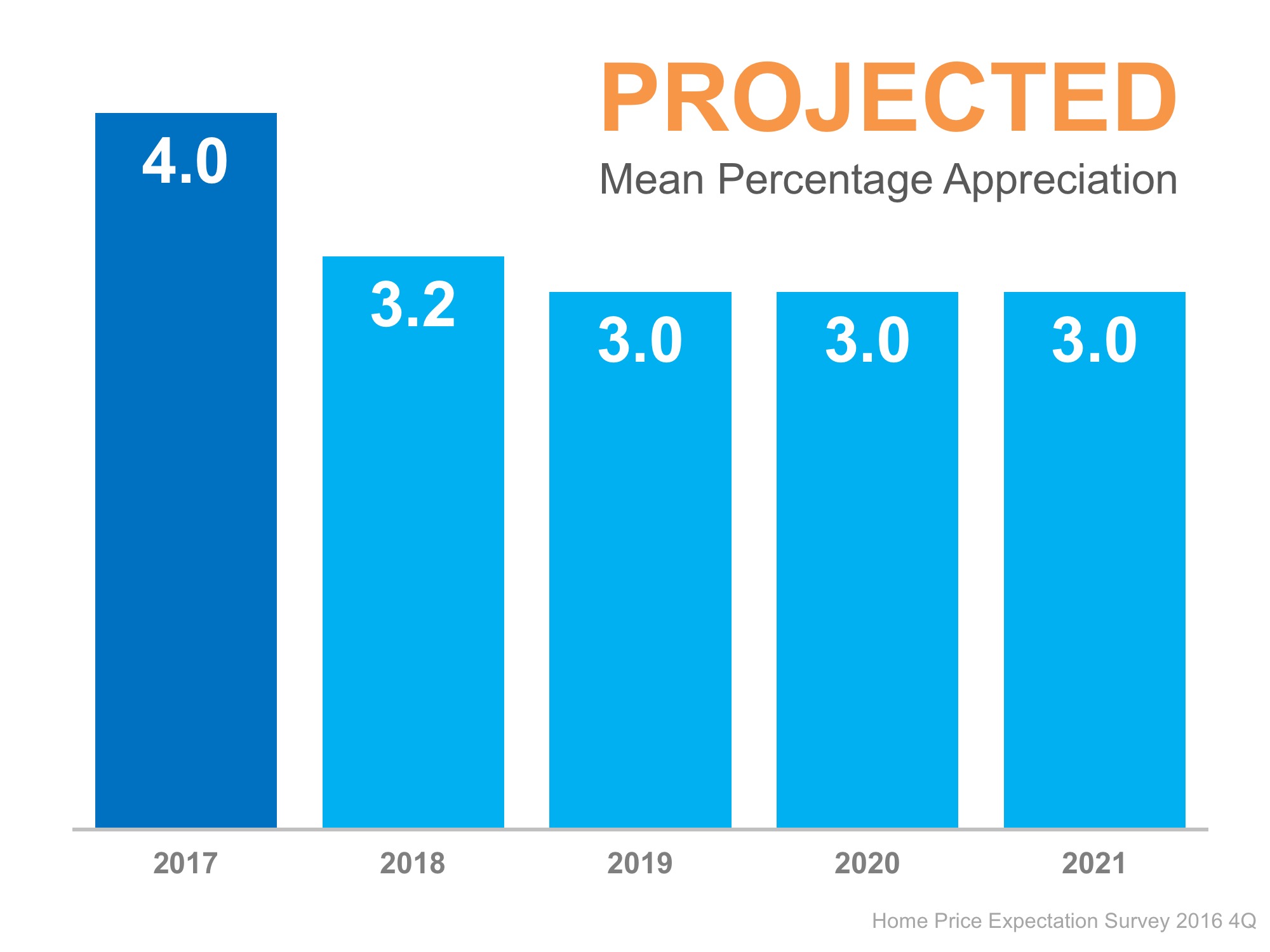
Home values will appreciate by 4.0% over the course of 2017, 3.2% in 2018 and 3.0% the next three years (as shown below). That means the average annual appreciation will be 3.24% over the next 5 years.
Home Prices: Where Will They Be in 5 Years? | MyKCM
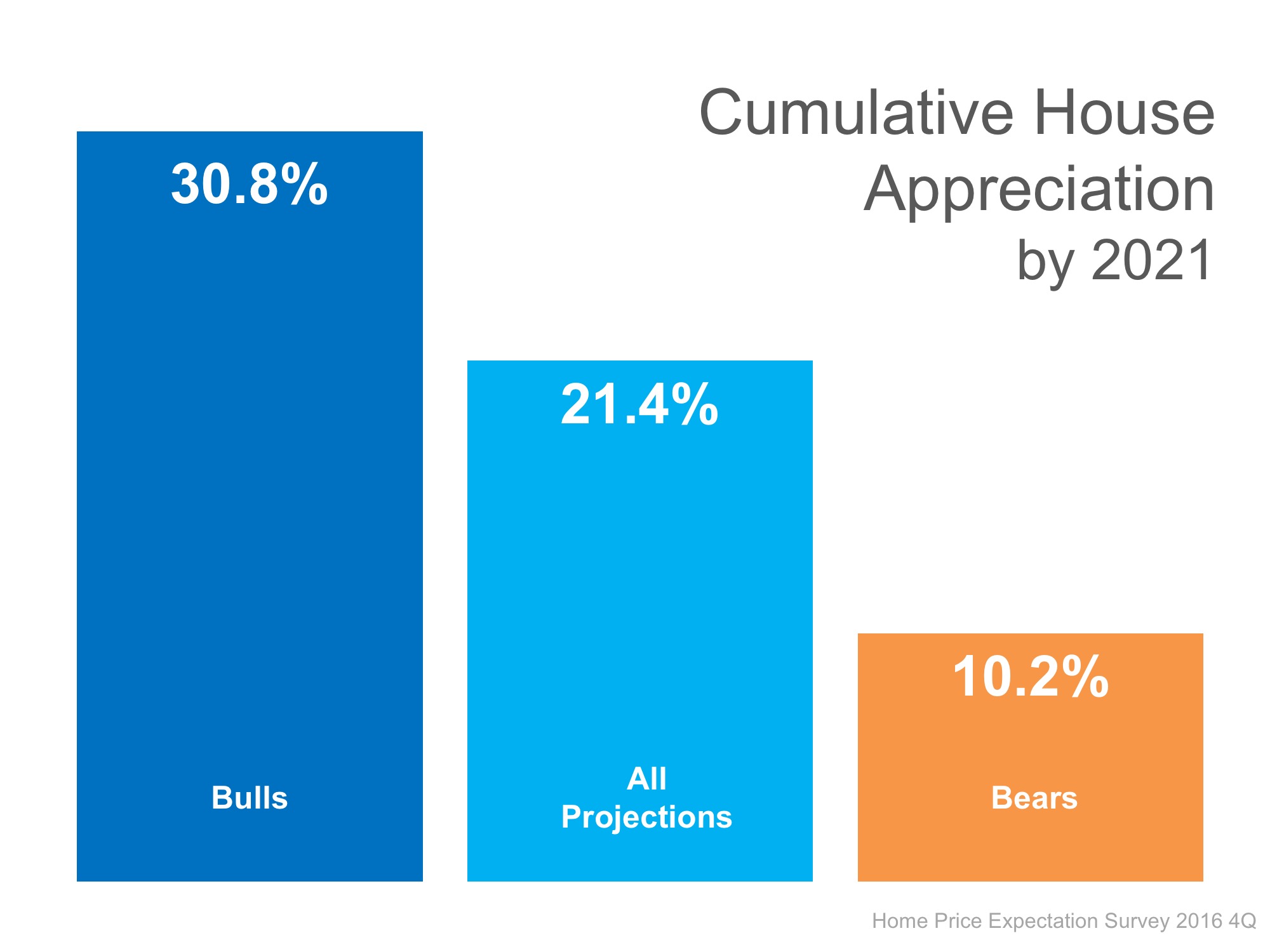
The prediction for cumulative appreciation ticked up from 18.7% to 21.4% by 2021. The experts making up the most bearish quartile of the survey are projecting a cumulative appreciation of 10.2%.
Home Prices: Where Will They Be in 5 Years? | MyKCM

Bottom Line

Individual opinions make headlines. We believe this survey is a fairer depiction of future values.

Thursday, December 8, 2016

Do you know the top 4 reasons why you shouldn't wait to buy a home this winter?

4 Reasons to Buy Your Dream Home This Winter

4 Reasons to Buy Your Dream Home This Winter | MyKCM
As the temperature in many areas of the country starts to cool down, you might think that the housing market will do the same. This couldn’t be further from the truth! Here are 4 reasons you should consider buying your dream home this winter instead of waiting for spring!

1. Prices Will Continue to Rise

CoreLogic’s latest Home Price Index reports that home prices have appreciated by 6.3% over the last 12 months. The same report predicts that prices will continue to increase at a rate of 5.2% over the next year.
The bottom in home prices has come and gone. Home values will continue to appreciate for years. Waiting no longer makes sense.

2. Mortgage Interest Rates are Projected to Increase

Your monthly housing cost is as much related to the price you pay for your home as it is to the mortgage interest rate you secure.
Freddie Mac’s Primary Mortgage Market Survey shows that interest rates for a 30-year mortgage are currently at 4.08%. The Mortgage Bankers Association, Fannie Mae, Freddie Mac & the National Association of Realtors are in unison, projecting that rates will increase by this time next year.
An increase in rates will impact YOUR monthly mortgage payment. A year from now, your housing expense will increase if a mortgage is necessary to buy your next home.

3. Either Way You’re Paying a Mortgage

There are some renters who have not yet purchased a home because they are uncomfortable taking on the obligation of a mortgage. Everyone should realize that, unless you are living with your parents rent free, you are paying a mortgage - either yours or your landlord’s.
As an owner, your mortgage payment is a form of ‘forced savings’ that allows you to have equity in your home that you can tap into later in life. As a renter, you guarantee your landlord is the person with that equity.
Are you ready to put your housing cost to work for you?

4. It’s Time to Move on with Your Life

The ‘cost’ of a home is determined by two major components: the price of the home and the current mortgage rate. It appears that both are on the rise.
But what if they weren’t? Would you wait?
Look at the actual reason you are buying and decide whether it is worth waiting. Whether you want to have a great place for your children to grow up, you want your family to be safer or you just want to have control over renovations, maybe now is the time to buy.

If the right thing for you and your family is to purchase a home this year, buying sooner rather than later could lead to substantial savings.

Monday, November 28, 2016

Negotiation skills, strong marketing presence, market knowledge...all reasons to hire a Realtor to help you sell your home.

5 Reasons to Hire a Real Estate Professional When Buying & Selling!

5 Reasons to Hire a Real Estate Professional When Buying & Selling! | MyKCM
Whether you are buying or selling a home, it can be quite an adventurous journey; you need an experienced Real Estate Professional to lead you to your ultimate goal. In this world of instant gratification and internet searches, many sellers think that they can For Sale by Owner or FSBO.
The 5 Reasons You NEED a Real Estate Professional in your corner haven’t changed, but rather have been strengthened, due to the projections of higher mortgage interest rates & home prices as the market continues to pick up steam. 

1. What do you do with all this paperwork?

Each state has different regulations regarding the contracts required for a successful sale, and these regulations are constantly changing. A true Real Estate Professional is an expert in their market and can guide you through the stacks of paperwork necessary to make your dream a reality.

2. Ok, so you found your dream house, now what?

According to the Orlando Regional REALTOR Association, there are over 230 possible actions that need to take place during every successful real estate transaction. Don’t you want someone who has been there before, someone who knows what these actions are, to make sure that you acquire your dream? 

3. Are you a good negotiator?

So maybe you’re not convinced that you need an agent to sell your home. However, after looking at the list of parties that you need to be prepared to negotiate with, you’ll realize the value in selecting a Real Estate Professional. From the buyer (who wants the best deal possible), to the home inspection companies, to the appraiser, there are at least 11 different people that you will have to be knowledgeable with and answer to, during the process. 

4. What is the home you’re buying/selling really worth?

It is important for your home to be priced correctly from the start to attract the right buyers and shorten the time that it’s on the market. You need someone who is not emotionally connected to your home to give you the truth as to your home’s value. According to the National Association of REALTORS, “the typical FSBO home sold for $185,000 compared to $245,000 among agent-assisted home sales.”
Get the most out of your transaction by hiring a professional.

5. Do you know what’s really going on in the market?

There is so much information out there on the news and the internet about home sales, prices, and mortgage rates; how do you know what’s going on specifically in your area? Who do you turn to in order to competitively price your home correctly at the beginning of the selling process? How do you know what to offer on your dream home without paying too much, or offending the seller with a lowball offer?
Dave Ramsey, the financial guru, advises:
“When getting help with money, whether it’s insurance, real estate or investments, you should always look for someone with the heart of a teacher, not the heart of a salesman.”
Hiring an agent who has their finger on the pulse of the market will make your buying or selling experience an educated one. You need someone who is going to tell you the truth, not just what they think you want to hear.

Bottom Line

You wouldn’t replace the engine in your car without a trusted mechanic. Why would you make one of the most important financial decisions of your life without hiring a Real Estate Professional?

Monday, November 21, 2016

Inventory is low, serious buyers are looking for homes, interest rates are still great and lenders aren't as busy - all great reasons to buy a home now!

Winter Is Coming… 5 Reasons to Sell Now!

Winter Is Coming… 5 Reasons to Sell Now! | MyKCM
People across the country are beginning to think about what their life will look like next year. It happens every fall; we ponder whether we should relocate to a different part of the country to find better year-round weather, or perhaps move across the state for better job opportunities. Homeowners in this situation must consider whether they should sell their house now or wait.

If you are one of these potential sellers, here are five important reasons to sell now instead of in the dead of winter.

1. Demand Is Strong

The latest Realtors’ Confidence Index from the National Association of Realtors (NAR) shows that buyer demand remains very strong throughout the vast majority of the country. These buyers are ready, willing and able to purchase… and are in the market right now!
Take advantage of the buyer activity currently in the market.

2. There Is Less Competition Now

According to NAR’s latest Existing Home Sales Report, the supply of homes for sale is still under the 6-month supply that is needed for a normal housing market (which is 4.5-months).
This means, in most areas, there are not enough homes for sale to satisfy the number of buyers in that market. This is good news for home prices. However, additional inventory is about to come to market.
There is a pent-up desire for many homeowners to move, as they were unable to sell over the last few years because of a negative equity situation. Homeowners are now seeing a return to positive equity as real estate values have increased over the last two years. Many of these homes will be coming to the market soon.
Also, as builders regain confidence in the market, new construction of single-family homes is projected to continue to increase, reaching historic levels in 2017. Last month’s new home sales numbers show that many buyers who have not been able to find their dream homes within the existing inventory have turned to new construction to fulfill their needs.
The choices buyers have will continue to increase. Don’t wait until all this other inventory of homes comes to market before you sell.

3. The Process Will Be Quicker

Fannie Mae announced that they anticipate an acceleration in home sales that will surpass 2007's pace. As the market heats up, banks will be inundated with loan inquiries causing closing timelines to lengthen. Selling now will make the process quicker & simpler. 

4. There Will Never Be a Better Time to Move Up

If you are moving up to a larger, more expensive home, consider doing it now. Prices are projected to appreciate by 5.2% over the next year, according to CoreLogic. If you are moving to a higher-priced home, it will wind up costing you more in raw dollars (both in down payment and mortgage payment) if you wait.
According to Freddie Mac’s latest report, you can also lock-in your 30-year housing expense with an interest rate around 3.57% right now. Interest rates are projected to increase moderately over the next 12 months. Even a small increase in rate will have a big impact on your housing cost.

5. It’s Time to Move On with Your Life

Look at the reason you decided to sell in the first place and determine whether it is worth waiting. Is money more important than being with family? Is money more important than your health? Is money more important than having the freedom to go on with your life the way you think you should?
Only you know the answers to the questions above. You have the power to take control of the situation by putting your home on the market. Perhaps the time has come for you and your family to move on and start living the life you desire.  

That is what is truly important.


Friday, November 18, 2016

Multi-gerational families, living under one roof, is making a comeback. What does that mean for housing?


From Empty Nest to Full House… Multigenerational Families Are Back!


From Empty Nest to Full House… Multigenerational Families Are Back! | MyKCM
Multigenerational homes are coming back in a big way! In the 1950s, about 21%, or 32.2 million Americans shared a roof with their grown children or parents. According to a recent Pew Research Center report, the number of multigenerational homes dropped to as low as 12% in 1980 but has shot back up to 19%, roughly 60.6 million people, as recently as 2014.
Multigenerational households typically occur when adult children (over the age of 25) either choose to, or need to, remain living in their parent’s home, and then have children of their own. These households also occur when grandparents join their adult children and grandchildren in their home.
According to the National Association of Realtors’ (NAR) 2016 Profile of Home Buyers and Sellers, 11% of home buyers purchased multigenerational homes last year. The top 3 reasons for purchasing this type of home were:
  • To take care of aging parents (19%)
  • Cost savings (18%, up from 15% last year)
  • Children over the age of 18 moving back home (14%, up from 11% last year)
Donna Butts, Executive Director of Generations United, points out that,
“As the face of America is changing, so are family structures. It shouldn’t be a taboo or looked down upon if grown children are living with their families or older adults are living with their grown children.”
For a long time, nuclear families (a couple and their dependent children) became the accepted norm, but John Graham, co-author of “Together Again: A Creative Guide to Successful Multigenerational Living,” says, “We’re getting back to the way human beings have always lived in – extended families.”
This shift can be attributed to several social changes over the decades. Growing racial and ethnic diversity in the U.S. population helps explain some of the rise in multigenerational living. The Asian and Hispanic populations are more likely to live in multigenerational family households and these two groups are growing rapidly.
Additionally, women are a bit more likely to live in multigenerational conditions than are their male counterparts (20% vs. 18%, respectively). Last but not least, basic economics.
Carmen Multhauf, co-author of the book “Generational Housing: Myth or Mastery for Real Estate,” brings to light the fact that rents and home prices have been skyrocketing in recent years. She says that, “The younger generations have not been able to save,” and often struggle to get good-paying jobs.

Bottom Line

Multigenerational households are making a comeback. While it is a shift from the more common nuclear home, these households might be the answer that many families are looking for as home prices continue to rise in response to a lack of housing inventory.

Tuesday, November 15, 2016

Foreclosures are at their lowest point in 8 years, buyer availability is at its' highest point in 8 years. Combined, that means a shortage of inventory in the market...


A Lack of Listings Remains 'Huge' Challenge in the Market


A Lack of Listings Remains ‘Huge’ Challenge in the Market | MyKCM
The housing crisis is finally in the rearview mirror as the real estate market moves down the road to a complete recovery. Home values are up, home sales are up, and distressed sales (foreclosures & short sales) are at their lowest mark in over 8 years. This has been, and will continue to be, a great year for real estate.
However, there is one thing that may cause the industry to tap the brakes: a lack of housing inventory. According to the National Association of Realtors (NAR), buyer traffic and demand continues to be the strongest it has been in years. The supply of homes for sale has not kept up with this demand and has driven prices up in many areas as buyers compete for their dream home.
Traditionally, the winter months create a natural slowdown in the market. Jonathan Smoke, Chief Economist at realtor.com, points to low interest rates as one of the many reasons why buyers are still out in force looking for a home of their own.
“Overall, the fundamental trends we have been seeing all year remain solidly in place as we enter the traditionally slower sales season, and pent-up demand remains substantial as buyers seek to get a home under contract while rates remain so low.”
NAR’s Chief Economist, Lawrence Yun, points out that the inventory shortage we are currently experiencing isn’t a new challenge by any means:
"Inventory has been extremely tight all year and is unlikely to improve now that the seasonal decline in listings is about to kick in. Unfortunately, there won't be much relief from new home construction, which continues to be grossly inadequate in relation to demand."

Bottom Line

Healthy labor markets and job growth have created more and more buyers who are not just ready and willing to buy but are also able to. If you are debating whether or not to put your home on the market this year, now is the time to take advantage of the demand in the market.

Monday, November 14, 2016

Inventory is still low. Thinking of selling your home? You might not want to wait...


Why Waiting Until After the Holidays to Sell Isn’t a Smart Decision


Why Waiting Until After the Holidays to Sell Isn’t a Smart Decision | MyKCM
Every year at this time, many homeowners decide to wait until after the holidays to put their homes on the market for the first time, while others who already have their homes on the market decide to take them off until after the holidays. Here are six great reasons not to wait:
  1. Relocation buyers are out there. Companies are not concerned with holiday time and if the buyers have kids, they want them to get into school after the holidays. 
  1. Purchasers that are looking for a home during the holidays are serious buyers and are ready to buy.
  1. You can restrict the showings on your home to the times you want it shown. You will remain in control.
  1. Homes show better when decorated for the holidays. 
  1. There is less competition for you as a seller right now. Let’s take a look at listing inventory as compared to the same time last year:
Why Waiting Until After the Holidays to Sell Isn’t a Smart Decision | MyKCM
  1. The supply of listings increases substantially after the holidays. Also, in many parts of the country, new construction will continue to surge reaching new heights in 2017, which will lessen the demand for your house.

Bottom Line

Waiting until after the holidays to sell your home probably doesn't make sense.

Thursday, November 10, 2016

Thanks to low interest rates, housing costs remain affordable.


The Truth About Housing Affordability


The Truth About Housing Affordability | MyKCM
From a purely economic perspective, this is one of the best times in American history to buy a home. Black Night Financial Services discusses this in their most recent Monthly Mortgage Monitor.
Here are two of the report’s revelations:
  1. The average U.S. home value increased by $13,500 from last year, but low interest rates have kept the monthly principal & interest payment needed to purchase a median-priced home almost equal to one year ago.
  2. Home affordability still remains favorable compared to long-term historic norms.
The report explains:
“Even though the value of the average home in the U.S. increased by about $13,500 over the last year, thanks to declining interest rates it actually costs almost exactly the same in principal and interest each month to purchase as it did this time last year.
Even taking into account the fact that affordability can vary – sometimes significantly – across the country based upon the different rates of home price appreciation we’re seeing, that’s a pretty incredible balancing act between interest rates and home prices at the national level…
Right now, it takes 20 percent of the median monthly income to cover monthly payments on the median-priced home, which is well below historical norms.”
However, the report warns that affordability will be dramatically impacted by an increase in mortgage rates.
“A half-point increase in interest rates would be equivalent to a $17,000 jump in the average home price, and bring that ratio to 21.5 percent. This increase is still below historical norms, but puts more pressure on homebuyers.”

Bottom Line

If you are ready and willing to purchase a home of your own, let's get together to find out if you are able to. Now is a great time to jump in.

Monday, November 7, 2016

Even though we are heading into the holiday season, there are signs that it is still a good time to sell your home...


NAR Reports Show Now Is a Great Time to Sell!


NAR Reports Show Now Is a Great Time to Sell! | MyKCM
We all realize that the best time to sell anything is when demand is high and the supply of that item is limited. The last two major reports issued by the National Association of Realtors (NAR) revealed information that suggests that now continues to be a great time to sell your house.
Let’s look at the data covered by the latest Pending Home Sales Report and Existing Home Sales Report.

THE PENDING HOME SALES REPORT

The report announced that pending home sales (homes going into contract) are up 2.4% over last year, and have increased year-over-year now for 22 of the last 25 consecutive months.
Lawrence Yun, NAR’s Chief Economist, had this to say:
"The one major predicament in the housing market is without a doubt the painfully low levels of housing inventory in much of the country. It's leading to home prices outpacing wages, properties selling a lot quicker than a year ago and the home search for many prospective buyers being highly competitive and drawn out because of a shortage of listings at affordable prices."
Takeaway: Demand for housing will continue throughout the end of 2016 and into 2017. The seasonal slowdown often felt in the winter months did not occur last winter and shows no signs of returning this year.

THE EXISTING HOME SALES REPORT

The most important data point revealed in the report was not sales, but was instead the inventory of homes for sale (supply). The report explained:
  • Total housing inventory rose 1.5% to 2.04 million homes available for sale
  • That represents a 4.5-month supply at the current sales pace
  • Unsold inventory is 6.8% lower than a year ago, marking the 16th consecutive month with year-over-year declines
There were two more interesting comments made by Yun in the report:
"Inventory has been extremely tight all year and is unlikely to improve now that the seasonal decline in listings is about to kick in. Unfortunately, there won't be much relief from new home construction, which continues to be grossly inadequate in relation to demand."
In real estate, there is a guideline that often applies; when there is less than a 6-month supply of inventory available, we are in a seller’s market and we will see appreciation. Between 6-7 months is a neutral market, where prices will increase at the rate of inflation. More than a 7-month supply means we are in a buyer’s market and should expect depreciation in home values. As Yun notes, we are, and will remain, in a seller’s market with prices still increasing unless more listings come to the market. 
"There's hope the leap in sales to first-time buyers can stick through the rest of the year and into next spring. The market fundamentals — primarily consistent job gains and affordable mortgage rates — are there for the steady rise in first-timers needed to finally reverse the decline in the homeownership rate."
Takeaway: Inventory of homes for sale is still well below the 6-month supply needed for a normal market. Prices will continue to rise if a ‘sizable’ supply does not enter the market.

Bottom Line

If you are going to sell, now may be the time to take advantage of the ready, willing, and able buyers that are still out looking for your house.

Thursday, November 3, 2016

Millennials are beginning to make their move...literally!


Think All Millennials Live in Their Parent's Basement? Think Again!


Think All Millennials Live in Their Parent's Basement? Think Again! | MyKCM
According to the Census Bureau, millennials have overtaken baby boomers as the largest generation in U.S. History. Millennials, or America's youth born between 1982-2000, now represent more than one quarter of the nation’s population, totaling 83.1 million.
There has been a lot of talk about how, as a generation, millennials have ‘failed to launch’ into adulthood and have delayed moving out of their family’s home. Some experts have even questioned whether or not millennials want to move out.
The great news is that not only do millennials want to move out… they are moving out! The National Association of Realtors (NAR) recently released their 2016 Profile of Home Buyers and Sellers in which they revealed that 61% of all first-time homebuyers were millennials in 2015!  
The median age of all first-time buyers in 2015 was 31 years old. 
Here is chart showing the breakdown by age:
Think All Millennials Live in Their Parent's Basement? Think Again! | MyKCM
Many social factors have contributed to millennials waiting to buy their first home. The latest Census results show that the median age of Americans at the time of their first marriage has increased significantly over the last 60 years, from 23 for men & 20 for women in 1955, to 29 & 27, respectively, in 2015.
Those who went to college and took out student loans are finally paying them off, as the terms on traditional student loans are 10 years. This means that a large portion of the generation is making its last loan payments and is working toward saving for a first home.
As a whole, the first-time homebuyer share increased to 35% of all buyers, up from 32% in 2014. Not all millennials are first-time buyers, they also made up 12% of all repeat buyers!

Bottom Line

Millennials will continue to drive the housing market next year, as well as in the years to come. As more and more realize that owning a home is within their grasp, they will flock to own their piece of the American Dream. Are you ready to buy your first or even second home?

Wednesday, November 2, 2016

The drop in housing values has extended the length of time the average homeowner has lived in their current house. This trend may change soon...


How Long Do Families Stay in a Home?


How Long Do Families Stay in a Home? | MyKCM
The National Association of Realtors (NAR) keeps historic data on many aspects of homeownership. One of the data points that has changed dramatically is the median tenure of a family in a home. As the graph below shows, for over twenty years (1985-2008), the median tenure averaged exactly six years. However, since 2008, that average is almost nine years – an increase of almost 50%.
How Long Do Families Stay in a Home? | MyKCM

Why the dramatic increase?

The reasons for this change are plentiful. The top two reasons are:
  1. The fall in home prices during the housing crisis left many homeowners in a negative equity situation (where their home was worth less than the mortgage on the property).
  2. The uncertainty of the economy made some homeowners much more fiscally conservative about making a move.
However, with home prices rising dramatically over the last several years, over 90% of homes with a mortgage are now in a positive equity situation with 70% of them having at least 20% equity.
And, with the economy coming back and wages starting to increase, many homeowners are in a much better financial situation than they were just a few short years ago.

What does this mean for housing?

Many believe that a large portion of homeowners are not in a house that is best for their current family circumstances. They could be baby boomers living in an empty, four-bedroom colonial, or a millennial couple planning to start a family that currently lives in a one-bedroom condo.
These homeowners are ready to make a move. Since the lack of housing inventory is a major challenge in the current housing market, this could be great news.

Monday, October 24, 2016

Bank appraisals continue to hinder sales in select markets...


Appraisers & Homeowners Don’t See Eye-To-Eye on Values


Appraisers & Homeowners Don’t See Eye-To-Eye on Values | MyKCM
In today’s housing market, where supply is very low and demand is very high, home values are increasing rapidly. Many experts are projecting that home values could appreciate by another 5%+ over the next twelve months. One major challenge in such a market is the bank appraisal.
If prices are surging, it is difficult for appraisers to find adequate, comparable sales (similar houses in the neighborhood that closed recently) to defend the selling price when performing the appraisal for the bank.
Every month, Quicken Loans measures the disparity between what a homeowner believes their house is worth as compared to an appraiser’s evaluation in their Home Price Perception Index (HPPI). Here is a chart showing that difference for each of the last 12 months.
Appraisers & Homeowners Don’t See Eye-To-Eye on Values | MyKCM

Bottom Line

Every house on the market has to be sold twice; once to a prospective buyer and then to the bank (through the bank’s appraisal). With escalating prices, the second sale might be even more difficult than the first. If you are planning on entering the housing market this year, let’s get together to discuss this, and any other obstacle that may arise.

Tuesday, October 4, 2016

Seller inventory remains low in Lake County, however the buyer demand isn't at the levels some of the other State's are experiencing...


Strong Buyer Demand Continues to Outpace Inventory of Homes for Sale


Strong Buyer Demand Continues to Outpace Inventory of Homes for Sale | MyKCM
The price of any item is determined by the supply of that item, as well as the market demand. The National Association of REALTORS (NAR) surveys “over 50,000 real estate practitioners about their expectations for home sales, prices and market conditions” for their monthly REALTORS Confidence Index.
Their latest edition sheds some light on the relationship between Seller Traffic (supply) and Buyer Traffic (demand).

Buyer Demand

The map below was created after asking the question: “How would your rate buyer traffic in your area?”
Strong Buyer Demand Continues to Outpace Inventory of Homes for Sale | MyKCM
The darker the blue, the stronger the demand for homes in that area. Only four states came in with a weak or moderate demand level.

Seller Supply

The Index also asked: “How would your rate seller traffic in your area?”
As you can see from the map below, the majority of the country has weak Seller Traffic, meaning there are far fewer homes on the market than what is needed to satisfy the buyers who are out looking for their dream homes.
Strong Buyer Demand Continues to Outpace Inventory of Homes for Sale | MyKCM

Bottom Line

Looking at the maps above, it is not hard to see why prices are appreciating in many areas of the country. Until the supply of homes for sale starts to meet the buyer demand, prices will continue to increase. If you are debating listing your home for sale, let’s get together and discuss the demand in our area.

Monday, October 3, 2016

Thinking of selling your home by yourself? Here are 5 reasons to use an agent instead...


Think You Should FSBO? 5 Reasons to Think Again!


Think You Should FSBO? 5 Reasons to Think Again! | MyKCM
In today’s market, with home prices rising and a lack of inventory, some homeowners may consider trying to sell their home on their own, known in the industry as a For Sale by Owner (FSBO). There are several reasons why this might not be a good idea for the vast majority of sellers.
Here are the top five reasons:

1. Exposure to Prospective Buyers

Recent studies have shown that 88% of buyers search online for a home. That is in comparison to only 21% looking at print newspaper ads. Most real estate agents have an internet strategy to promote the sale of your home. Do you? 

2. Results Come from the Internet

Where did buyers find the home they actually purchased?
  • 44% on the internet
  • 33% from a Real Estate Agent
  • 9% from a yard sign
  • 1% from newspapers
The days of selling your house by just putting up a sign and putting it in the paper are long gone. Having a strong internet strategy is crucial. 

3. There Are Too Many People to Negotiate With

Here is a list of some of the people with whom you must be prepared to negotiate if you decide to For Sale By Owner:
  • The buyer who wants the best deal possible
  • The buyer’s agent who solely represents the best interest of the buyer
  • The buyer’s attorney (in some parts of the country)
  • The home inspection companies, which work for the buyer and will almost always find some problems with the house
  • The appraiser if there is a question of value

4. FSBOing Has Become More And More Difficult

The paperwork involved in selling and buying a home has increased dramatically as industry disclosures and regulations have become mandatory. This is one of the reasons that the percentage of people FSBOing has dropped from 19% to 8% over the last 20+ years.

The 8% share represents the lowest recorded figure since NAR began collecting data in 1981.

5. You Net More Money When Using an Agent

Many homeowners believe that they will save the real estate commission by selling on their own. Realize that the main reason buyers look at FSBOs is because they also believe they can save the real estate agent’s commission. The seller and buyer can’t both save the commission.
Studies have shown that the typical house sold by the homeowner sells for $210,000, while the typical house sold by an agent sells for $249,000. This doesn’t mean that an agent can get $39,000 more for your home, as studies have shown that people are more likely to FSBO in markets with lower price points. However, it does show that selling on your own might not make sense.

Bottom Line

Before you decide to take on the challenges of selling your house on your own, sit with a real estate professional in your marketplace and see what they have to offer.

Tuesday, September 27, 2016

Unless you are in Dallas, Denver or Houston...the housing market is leaning favorably to buying a home over renting...


US Housing Market Moving Further into ‘Buy Territory’


US Housing Market Moving Further into ‘Buy Territory’ | MyKCM
According to the latest Beracha, Hardin & Johnson Buy vs. Rent (BH&J) Index, the U.S. housing market has continued to move deeper into buy territory, supporting the belief that housing markets across the country remain a sound investment.
The BH&J Index is a quarterly report that attempts to answer the question:

In today’s housing market, is it better to rent or buy a home?

The index examines the entire US housing market and then isolates 23 major cities for comparison. The researchers “measure the relationship between purchasing property and building wealth through a buildup in equity versus renting a comparable property and investing in a portfolio of stocks and bonds.” 
Ken Johnson, Ph.D., Real Estate Economist & Professor at Florida Atlantic University, and one of the index’s authors explains that:
“Housing prices, in general, continue to slow and when considered in light of the recent trends in the Buy vs. Rent Index signal that ownership remains an excellent investment for the majority of Americans.”
While 15 of the 23 metropolitan markets examined moved further into buy territory since last quarter, Dallas, Denver, and Houston are three of the major cities that are currently deep into rent territory. In these three markets, it is estimated that renting will top homeownership 7 out of 10 times.
Eli Beracha, Ph.D., Assistant Professor in the T&S Hollo School of Real Estate at FIU, believes that, in these three markets, the strong odds in favor of renting to create more wealth should begin to have an impact on the demand for home ownership and from that, impact property prices in these areas.”
Simply put, home prices in these areas will begin to return to more normal levels once residents realize that renting may be a better choice, therefore bringing home affordability back as well.

Bottom Line

The majority of the country is strongly in buy territory. Buying a home makes sense socially and financially. Rents are predicted to increase substantially in the next year. Protect yourself from rising rents by locking in your housing cost with a mortgage payment now.
To Find Out More About the Study: The BH&J Index and other FAU real estate activities are sponsored by Investments Limited of Boca Raton. The BH&J Index is published quarterly and is available online at http://business.fau.edu/buyvsrent.

Friday, September 23, 2016

Good news for the housing market - preforeclosure levels are back to what they were before the housing crisis hit...


Foreclosure Rate Drops to Pre-Crisis Levels


Foreclosure Rate Drops to Pre-Crisis Levels [INFOGRAPHIC] | MyKCM
Some Highlights:
  • Only 2.9% of homes are in serious delinquency, down 17.1% from July 2015.
  • This is the 57th consecutive month with a year-over-year decline.
  • The national foreclosure rate has returned to August 2007 levels, at only 0.9%.

Thursday, September 22, 2016

Mortgage availability, demand for housing, and new home starts are all increasing. Positive signs for a strengthening housing market...


5 Stats That Prove the Real Estate Market Is Getting Stronger


5 Stats that Prove the Real Estate Market is Getting Stronger | MyKCM
Whenever there is talk about an improving housing market, some begin to show concern that we may be headed toward another housing bubble that will be followed by a crash similar to the one we saw last decade.
Here are five data points that show the housing market will continue to recover, and that a new housing crisis is not about to take shape.
1) Mortgage availability is increasing, but is nowhere near the levels we saw in 2004-2006.
A buyer’s chances of being approved for a mortgage have increased over the last three years; That’s good news for the market. This is not a precursor to another challenge, as many experts maintain that it is still too difficult for many buyers to attain house financing.
As Jonathan Smoke, the Chief Economist of realtor.com, recently explained:
“The havoc during the last cycle was the result…of speculation fueled by loose credit. That’s the exact opposite of what we have today.”
2) The Housing Affordability Index, which measures whether or not a typical family earns enough income to qualify for a mortgage loan on a typical home, based on the most recent price and income data. The current index shows that it is more affordable to buy a home today than at any other time between 1990 and 2008. With median incomes finally beginning to rise, houses should continue to remain affordable and housing demand should remain strong.
3) Home prices are well within historic norms. Prices have increased substantially over the last several years; However, those increases followed the housing crash of 2008 and national prices are still not back to 2006 levels. If there were no bubble (and subsequent bust), today’s prices would actually be lower than if they were measured by historic appreciation levels from 1987-1999.
4) Demand for housing, as measured by new household formations, is growing. The Urban Land Institute projects that 5.95 million new households will be formed over the next three years. Even if the homeownership rate drops to 60%, that would be over 3.5 million new homeowners entering the market.
5) New home starts are finally beginning to increase. This helps eliminate the number one challenge in the industry – lack of inventory. And it does so in two ways:
  1. Some first time buyers will, in fact, purchase a newly constructed home.
  2. Many current homeowners will move-up (or move-down) to a new construction and then put their current home on the market.
This means that there will be an increase in both new construction and existing home inventories.