Showing posts with label mortgage. Show all posts

Wednesday, November 14, 2018

Do you know any Veterans or active military personnel that would like to buy a home? The VA loan program has some terrific benefits, and is exclusive to these folks! Questions? Contact me!!

VA Home Loans by the Numbers [INFOGRAPHIC]

VA Home Loans by the Numbers [INFOGRAPHIC] | MyKCM

Some Highlights:

  • The Veterans Administration (VA) Home Loan is a benefit that is available to more than 22 million veterans & 2 million active duty service members which helps them achieve their dreams of homeownership.
  • In 2017, $189 billion was loaned to veterans and their families through the program.
  • VA Purchase Loans are on the rise in 46 out of 50 states and Washington, DC

Monday, October 29, 2018

Wouldn't you rather build your own equity, as opposed to someone else's?

Rent or Buy: Either Way You’re Paying A Mortgage!

Rent or Buy: Either Way You’re Paying A Mortgage! | MyKCM

There are some people who have not purchased homes because they are uncomfortable taking on the obligation of a mortgage. Everyone should realize, however, that unless you are living with your parents rent-free, you are paying a mortgage – either yours or your landlord’s.
As Entrepreneur Magazine, a premier source for small business, explained in their article, “12 Practical Steps to Getting Rich”:
“While renting on a temporary basis isn’t terrible, you should most certainly own the roof over your head if you’re serious about your finances. It won’t make you rich overnight, but by renting, you’re paying someone else’s mortgage. In effect, you’re making someone else rich.”
With home prices rising, many renters are concerned about their house-buying power. Mark Fleming, Chief Economist at First American, explained:
Over the last three years, renter house-buying power has increased fast enough to keep pace with house price appreciation, so the share of homes that a renter can afford to buy has remained the same since 2015.
Although mortgage rates are expected to rise, they are still low by historic standards, and real household incomes are the highest they have ever been. Assuming this trend continues, our measure of affordability, which takes into account income, interest rates, and house prices, indicates that homeownership is still within reach for renters.”
As an owner, your mortgage payment is a form of ‘forced savings’ which allows you to build equity in your home that you can tap into later in life. As a renter, you guarantee the landlord is the person building that equity.
Interest rates are still at historic lows, making it one of the best times to secure a mortgage and make a move into your dream home. Freddie Mac’s latest report shows that rates across the country were at 4.51% last week.

Bottom Line

Whether you are looking for a primary residence for the first time or are considering a vacation home on the shore, now may be the time to buy.

Wednesday, October 10, 2018

Nobody wants to pay PMI, but did you know that it may actually work out in your favor?

The Cost of NOT Paying PMI

The Cost of NOT Paying PMI | MyKCM
Saving for a down payment is often the biggest hurdle for a first-time homebuyer as median incomes, rents, and home prices all vary depending on where you live.
There is a common misconception among homebuyers that a 20% down payment is required, and it is this limiting belief that often adds months, and sometimes even years, to the home-buying process.

So, if you can purchase a home with less than a 20% down payment… why aren’t more people doing just that?

One Possible Answer: Private Mortgage Insurance (PMI)
Freddie Mac defines PMI as:
“An insurance policy that protects the lender if you are unable to pay your mortgage. It’s a monthly fee, rolled into your mortgage payment, that is required for all conforming, conventional loans that have down payments less than 20%.
Once you’ve built equity of 20% in your home, you can cancel your PMI and remove that expense from your mortgage payment.”
As the borrower, you pay the monthly premiums for the insurance policy, and the lender is the beneficiary. The monthly cost of your PMI depends on the home’s value, the amount of your down payment, and your credit score.
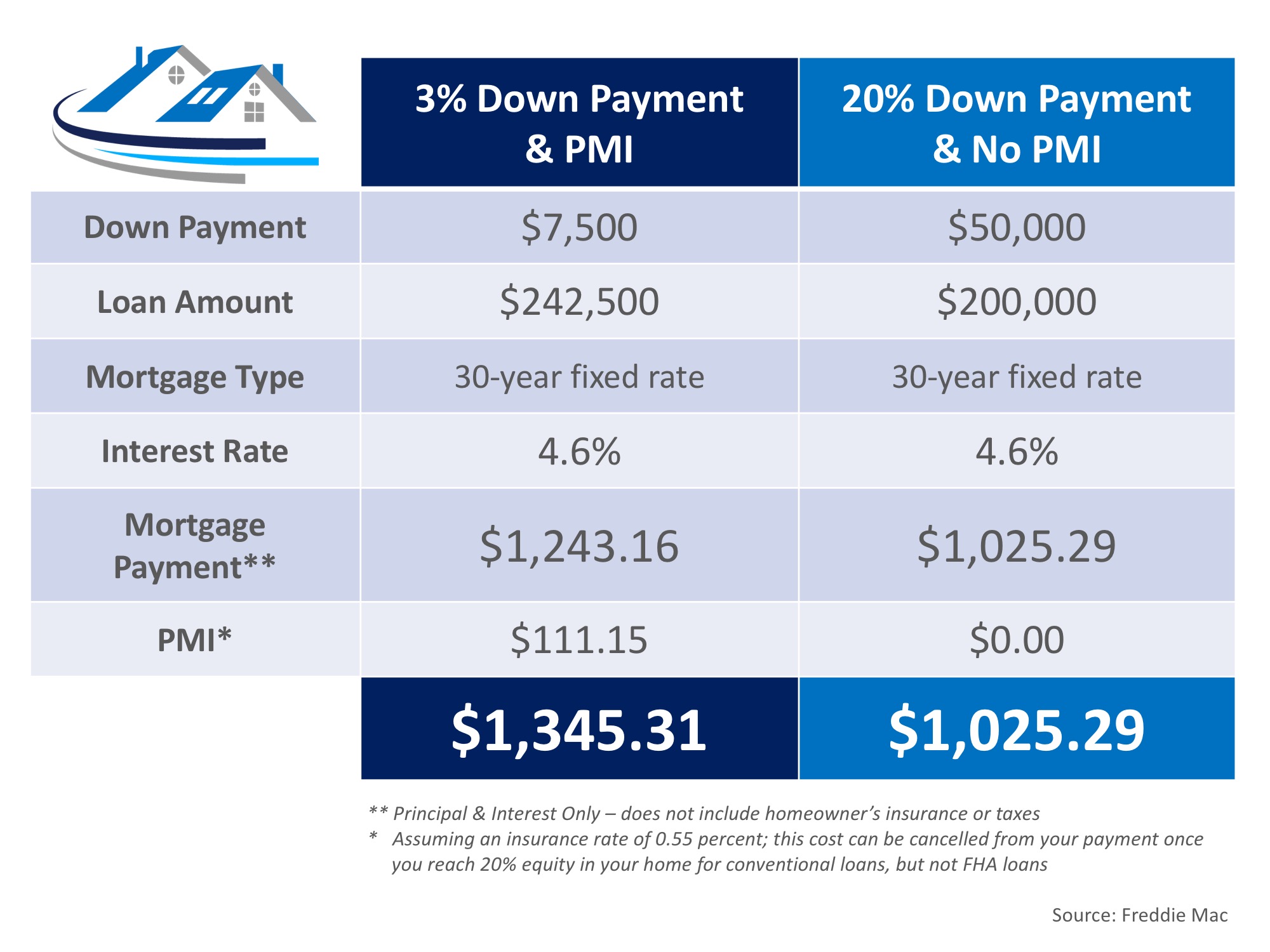
Below is a table showing the difference in monthly mortgage payment for a $250,000 home with a 3% down payment and PMI vs. a 20% down payment without PMI:
The Cost of NOT Paying PMI | MyKCM
The first thing you see when looking at the table above is no doubt the added $320 a month that you would be spending on your monthly mortgage cost. The second thing that should stand out is that a 20% down payment is $50,000!
If you are buying your first home, $50,000 is a large sum of money that takes discipline and sacrifice to save. Many first-time buyers save for 5-10 years before buying their homes.
To save $50,000 in 10 years, you would need to save about $420 a month. On the other hand, if you save that same $420 a month, you could afford a 3% down payment in less than a year and a half.
In a recent article by My Mortgage Insider, they explain what could happen in the market while you are waiting to save for a higher down payment:
“The time it takes to save a (larger) down payment could mean higher home prices and tougher qualifying down the road. For many buyers, it could prove much cheaper and quicker to opt for the 3% down mortgage immediately.”
The article went on to say,
“Since renters typically devote a higher percentage of their income to housing than homeowners, providing flexible down payment options can help renters with solid earnings purchase a home – and gain a fixed-rate mortgage with principal and interest payments that will not increase over the life of the loan.”
If the prospect of having to pay PMI is holding you back from buying a home today, Freddie Mac has this advice,
“It’s no doubt an added cost, but it’s enabling you to buy now and begin building equity versus waiting 5 to 10 years to build enough savings for a 20% down payment.”
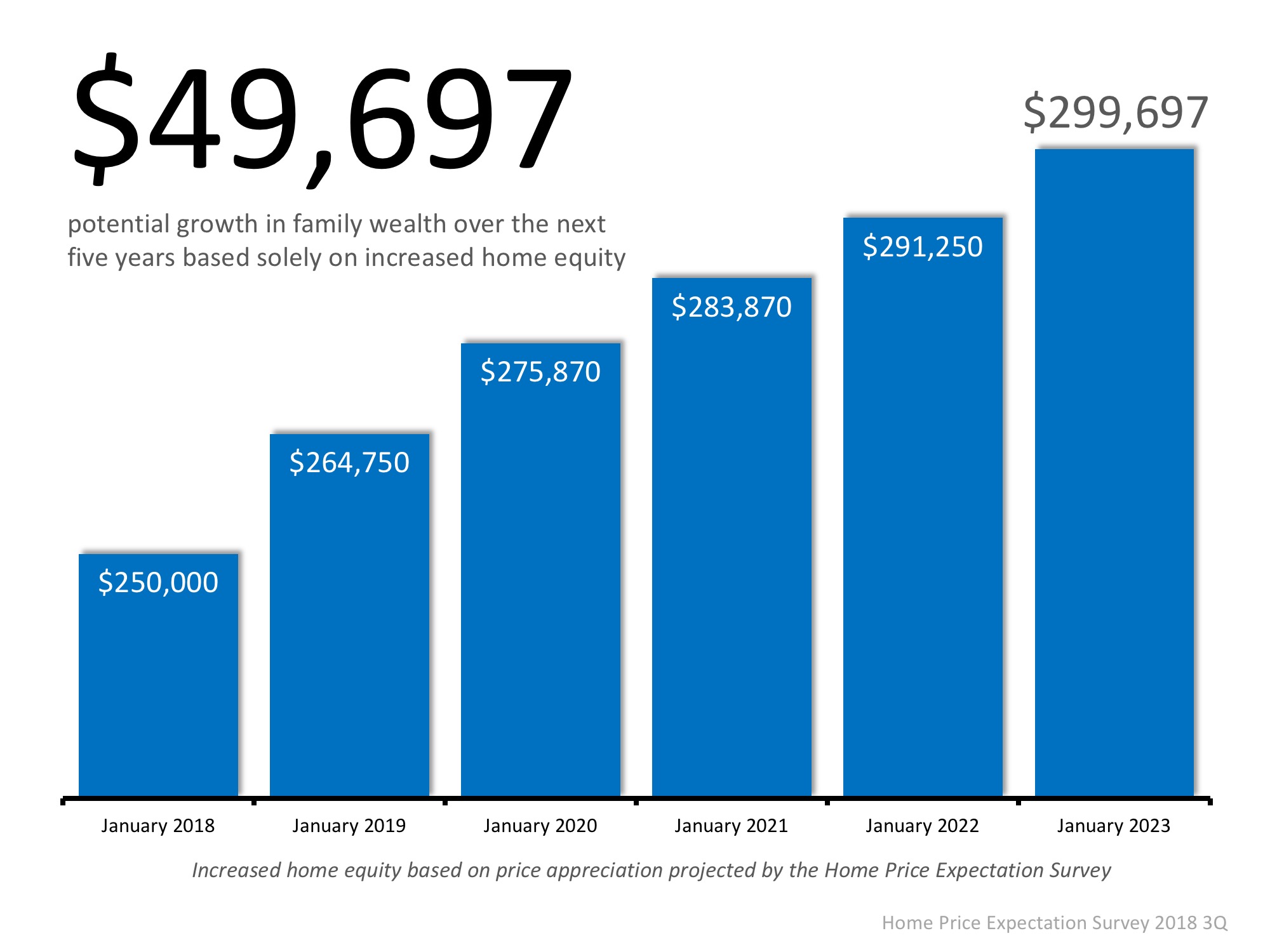
Based on results of the most recent Home Price Expectation Survey, a homeowner who purchased a $250,000 home in January would gain $50,000 in equity over the next five years based on home price appreciation alone (shown below).
The Cost of NOT Paying PMI | MyKCM

Bottom Line

If you have questions about whether you should buy now or wait until you’ve saved a larger down payment, let’s get together to discuss our market’s conditions and help you make the best decision for you and your family.

Monday, October 8, 2018

Could mortgage rates rise above 5% next year?

Where Are Mortgage Interest Rates Headed In 2019?

Where Are Mortgage Interest Rates Headed In 2019? | MyKCM
The interest rate you pay on your home mortgage has a direct impact on your monthly payment; the higher the rate, the greater the payment will be. That is why it is important to know where rates are headed when deciding to start your home search.
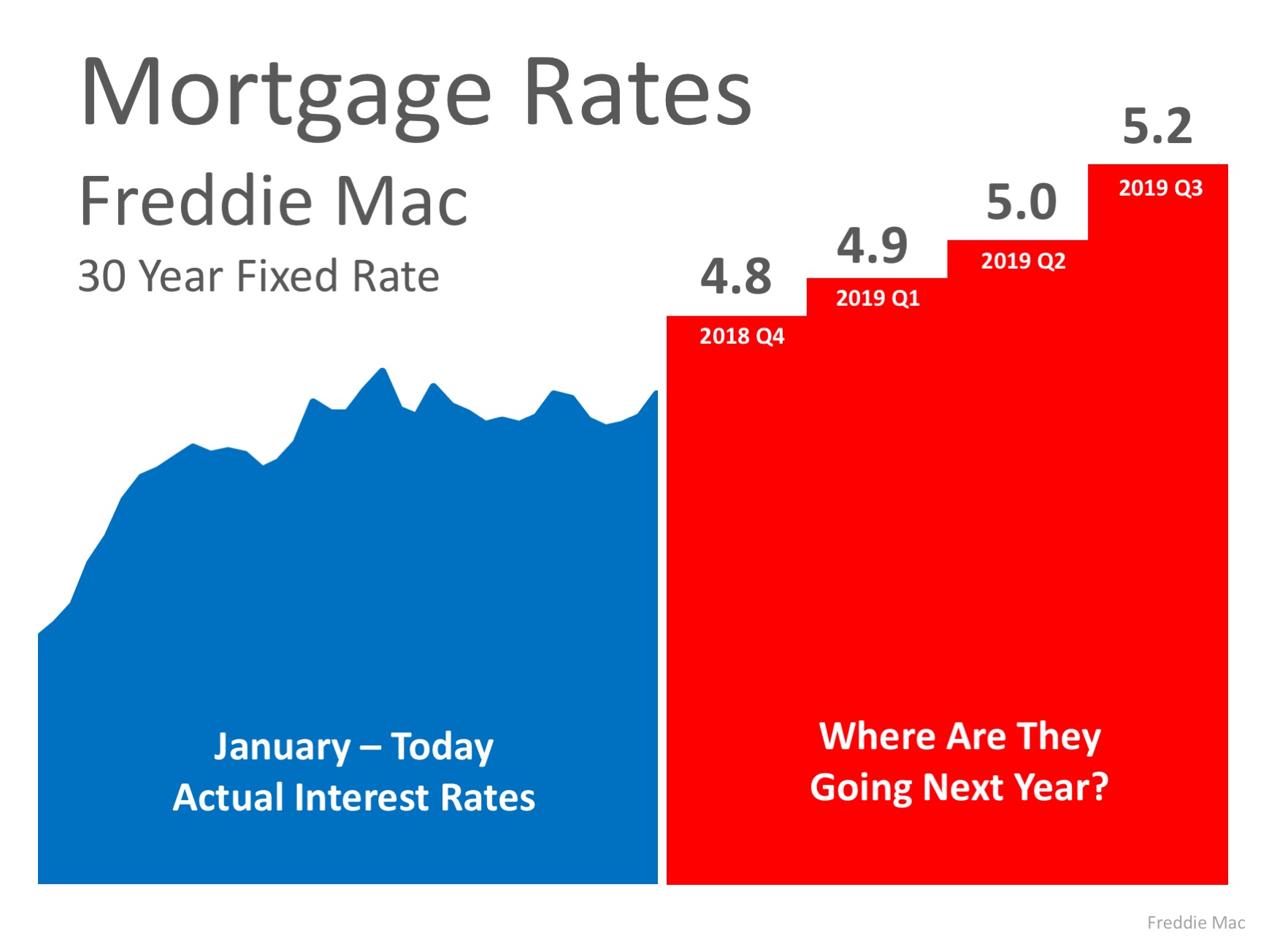
Below is a chart created using Freddie Mac’s U.S. Economic & Housing Marketing Outlook. As you can see, interest rates are projected to increase steadily over the course of the next year.
Where Are Mortgage Interest Rates Headed In 2019? | MyKCM

How Will This Impact Your Mortgage Payment?

Depending on the amount of the loan that you secure, a half of a percent (.5%) increase in interest rate can increase your monthly mortgage payment significantly.
According to CoreLogic’s latest Home Price Index, national home prices have appreciated 6.2% from this time last year and are predicted to be 5.1% higher next year.
If both the predictions of home price and interest rate increases become a reality, families would wind up paying considerably more for their next homes.

Bottom Line

Even a small increase in interest rate can impact your family’s wealth, so don’t wait until next year! Let’s get together to evaluate your ability to purchase your dream home now.

Tuesday, October 2, 2018

While you may have missed the lowest interest rates in decades, rates are still at a level that gives you lots of buying power...

Mortgage Interest Rates are Still Going Up… Should You Wait to Buy?

Mortgage Interest Rates are Still Going Up… Should You Wait to Buy? | MyKCM
Mortgage interest rates, as reported by Freddie Mac, have increased by close to a quarter of a percent over the last several weeks. Freddie Mac, Fannie Mae, the Mortgage Bankers Association, and the National Association of Realtors are all calling for mortgage rates to rise another quarter of a percent by next year.
In addition to the predictions from the four major reporting agencies mentioned above, the Federal Open Market Committee recently voted “unanimously to approve a 1/4 percentage point increase in the primary credit rate to 2.75 percent.” Historically, an increase in the primary credit rate has translated to an overall jump in mortgage interest rates as well.
This has caused some purchasers to lament the fact that they may no longer be able to get a rate below 4%. However, we must realize that current rates are still at historic lows.
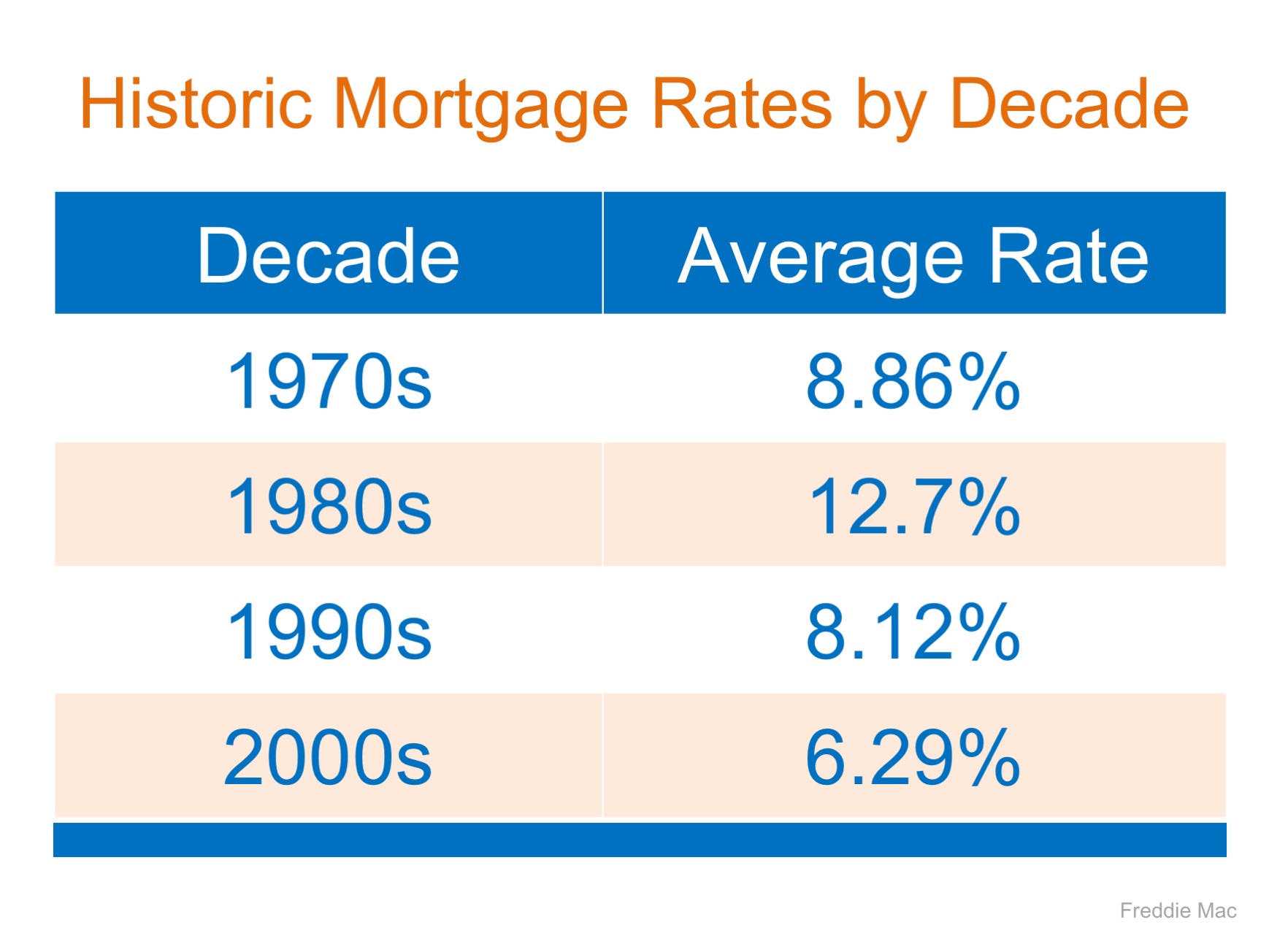
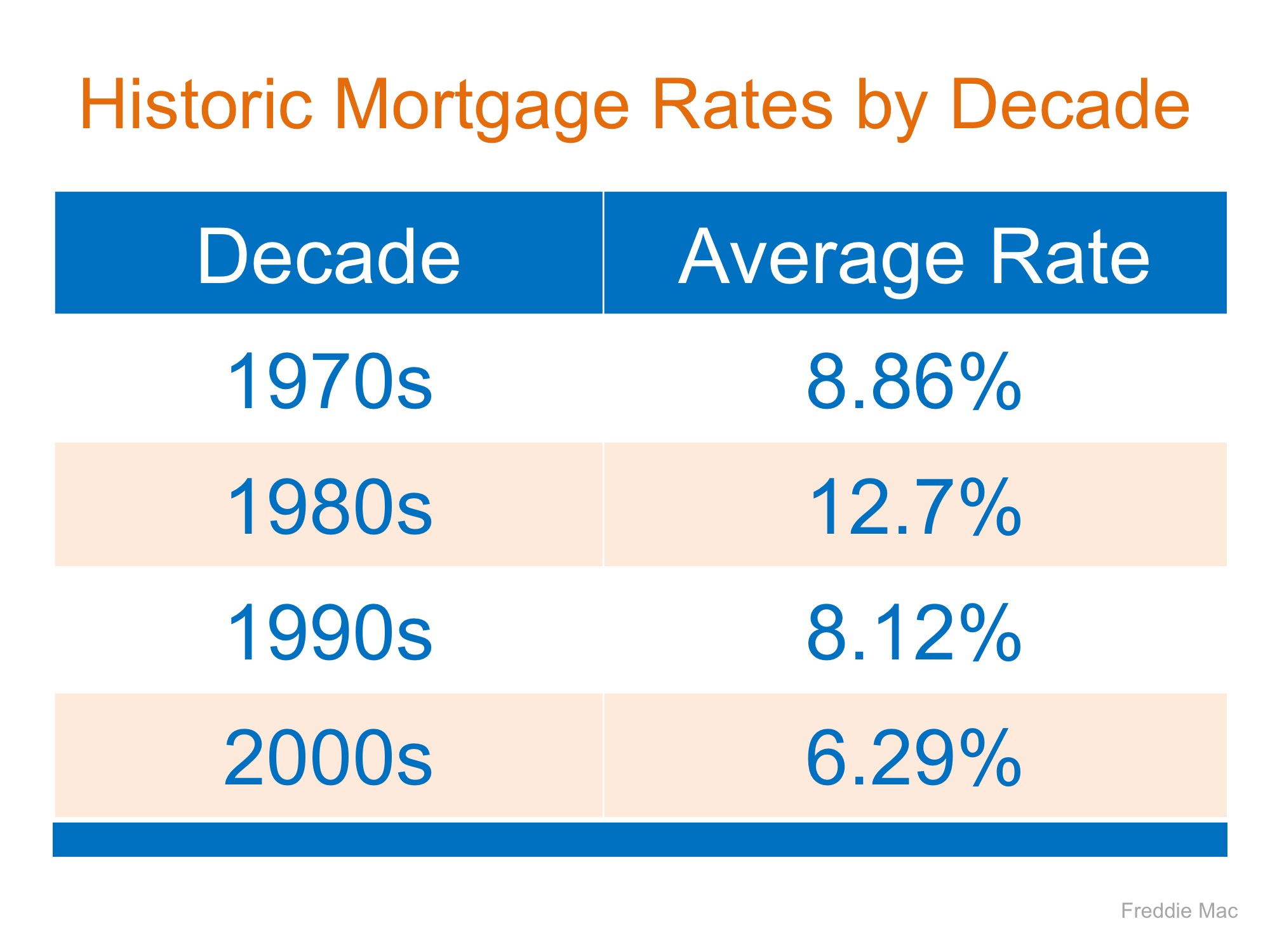
Here is a chart showing the average mortgage interest rate over the last several decades:
Mortgage Interest Rates are Still Going Up… Should You Wait to Buy? | MyKCM

Bottom Line

Though you may have missed the lowest mortgage rate ever offered, you can still get a better interest rate than your older brother or sister did ten years ago, a lower rate than your parents did twenty years ago, and a better rate than your grandparents did forty years ago.

Wednesday, July 25, 2018

Think that you are ready to buy a home? Here are some things you need to know before you start the process...

What You Need to Know About the Mortgage Process
What You Need to Know About the Mortgage Process [INFOGRAPHIC] | MyKCM

Some Highlights:

  • Many buyers are purchasing a home with a down payment as little as 3%.
  • You may already qualify for a loan, even if you don’t have perfect credit.
  • Take advantage of the knowledge of your local professionals who are there to help you determine how much you can afford.

Thursday, May 31, 2018

How can rising mortgage interest rates be a good thing?

Why Have Interest Rates Jumped to a 7-Year High?

Why Have Interest Rates Jumped to a 7-Year High? | MyKCM
Interest rates for a 30-year fixed rate mortgage have climbed from 3.95% in the first week of January up to 4.61% last week, which marks a 7-year high according to Freddie Mac. The current pace of acceleration has been fueled by many factors.
Sam Khater, Freddie Mac’s Chief Economist, had this to say:
“Healthy consumer spending and higher commodity prices spooked bond markets and led to higher mortgage rates over the past week.
Not only are buyers facing higher borrowing costs, gas prices are currently at four-year highs just as we enter the important peak home sales season.”

But what do gas prices have to do with interest rates?

Investopedia explains the relationship like this:
“The price of oil and inflation are often seen as being connected in a cause-and-effect relationship. As oil prices move up or down, inflation follows in the same direction.”
You may have noticed that filling your gas tank has become substantially more expensive in recent months. The average national gas price has climbed nearly $0.50 from the beginning of the year, leading to the highest price for Memorial Day weekend since 2014.
As rates go up, your purchasing power goes down, but don’t worry; rates are still well below the averages we’ve seen over the last four decades.
“Freddie Mac said this year’s higher rates have not yet caused much of a ripple in the strong demand levels for buying a home seen in most markets, but inflationary pressures and the prospect of rates approaching 5 percent could begin to hit the psyche of some prospective buyers.”
Buying sooner rather than later will help lock in a lower rate than waiting, as the experts believe rates will continue to climb. Even a small increase in interest rates can have a big impact on your monthly housing cost.

Bottom Line

If you are planning on buying a home this year, keep an eye on gas prices the next time you’re at the pump. If you start to feel a big jump in price, know that rates are probably on their way up, too.

Friday, February 9, 2018

Think you only have to sell your home to A buyer? Guess again....


Homeowners: Your House Must Be Sold TWICE


Homeowners: Your House Must Be Sold TWICE | MyKCM
In today’s housing market, where supply is very low and demand is very high, home values are increasing rapidly. Many experts are projecting that home values could appreciate by another 5%+ over the next twelve months. One major challenge in such a market is the bank appraisal.
If prices are surging, it is difficult for appraisers to find adequate, comparable sales (similar houses in the neighborhood that recently closed) to defend the selling price when performing the appraisal for the bank.
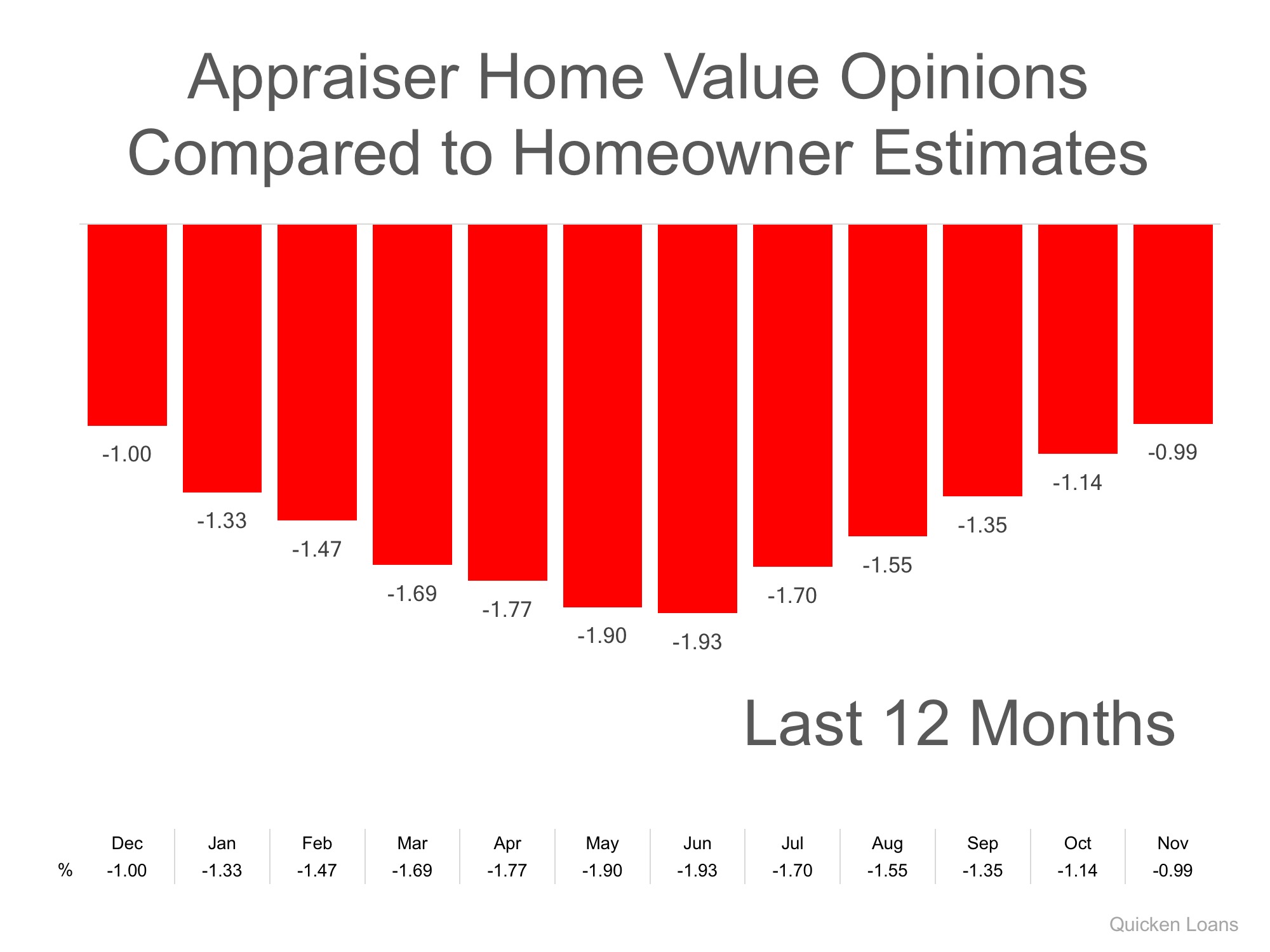
Every month in their Home Price Perception Index (HPPI), Quicken Loans measures the disparity between what a homeowner who is seeking to refinance their home believes their house is worth, and an appraiser’s evaluation of that same home.
Bill Banfield, Executive VP of Capital Markets at Quicken Loans urges anyone looking to buy or sell in today’s market to remember the impact of this challenge:
“Based on the HPPI, it appears homeowners in the markets where prices are rising faster than the national average – like Denver, Seattle and San Francisco – are continuing to underestimate just how quickly home values are rising, so the average appraisal is higher than homeowner estimate.
On the inverse of that, homeowners in areas where the values aren’t rising as fast may think they are rising faster than they are, leading to the appraisal lagging the estimate.”
The chart below illustrates the changes in home price estimates over the last 12 months.
Homeowners: Your House Must Be Sold TWICE | MyKCM

Bottom Line

Every house on the market must be sold twice; once to a prospective buyer and then to the bank (through the bank’s appraisal). With escalating prices, the second sale might be even more difficult than the first. If you are planning on entering the housing market this year, let’s get together to discuss this and any other obstacles that may arise.

Friday, February 2, 2018

The lower the interest rate, the higher your buying power!


Low Interest Rates Have a High Impact on Your Purchasing Power


According to Freddie Mac’s latest Primary Mortgage Market Survey, interest rates for a 30-year fixed rate mortgage are currently at 3.92%, which is still near record lows in comparison to recent history!
The interest rate you secure when buying a home not only greatly impacts your monthly housing costs, but also impacts your purchasing power.
Purchasing power, simply put, is the amount of home you can afford to buy for the budget you have available to spend. As rates increase, the price of the house you can afford will decrease if you plan to stay within a certain monthly housing budget.
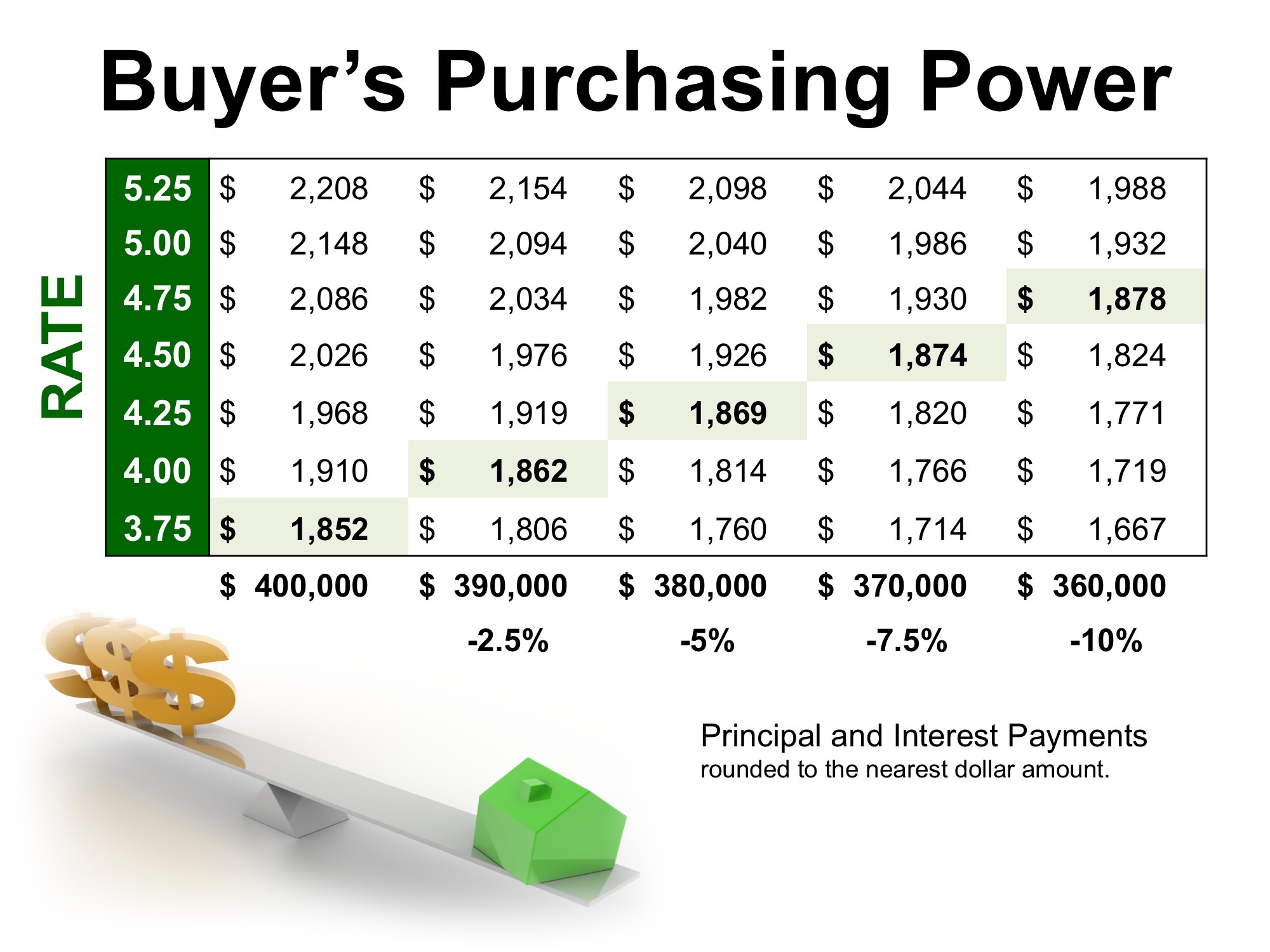
The chart below shows what impact rising interest rates would have if you planned to purchase a home within the national median price range, and planned to keep your principal and interest payments between $1,850-$1,900 a month.
Low Interest Rates Have a High Impact on Your Purchasing Power | MyKCM
With each quarter of a percent increase in interest rate, the value of the home you can afford decreases by 2.5% (in this example, $10,000). Experts predict that mortgage rates will be closer to 5% by this time next year.

Act now to get the most house for your hard-earned money.

Thursday, January 18, 2018

Is a new home one of your 2018 goals? Let's make it a reality!

3 Tips for Making Your Dream Home a Reality [INFOGRAPHIC]

3 Tips for Making Your Dream Home a Reality [INFOGRAPHIC] | MyKCM

Some Highlights:

  • Realtor.com shared their “5 Habits to Start Now If You Hope to Buy a Home.”
  • Setting up an automatic savings plan that saves a small amount of every check is one of the best ways to save without thinking a lot about it.
  • Living within a budget will not only help you save money for down payments but will help you pay down other debts that might be holding you back.

Monday, January 8, 2018

It is easier to get a mortgage now, than it was a year ago. But that doesn't mean that we are headed for trouble...

Bubble Alert! Is it Getting Too Easy to Get a Mortgage?

Bubble Alert! Is it Getting Too Easy to Get a Mortgage? | MyKCM
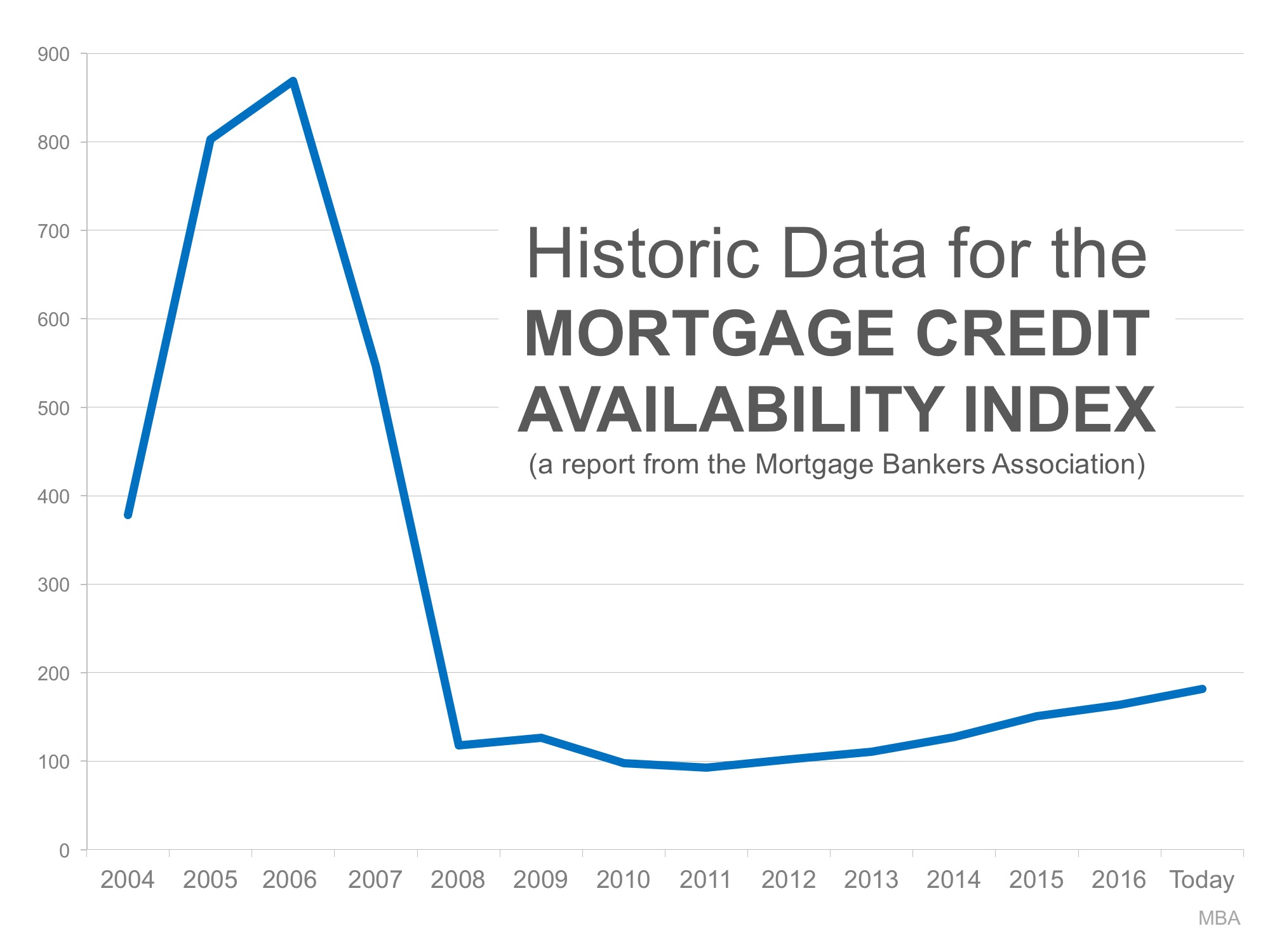
There is little doubt that it is easier to get a home mortgage today than it was last year. The Mortgage Credit Availability Index (MCAI), published by the Mortgage Bankers Association, shows that mortgage credit has become more available in each of the last several years. In fact, in just the last year:
  • More buyers are putting less than 20% down to purchase a home
  • The average credit score on closed mortgages is lower
  • More low-down-payment programs have been introduced
This has some people worrying that we are returning to the lax lending standards which led to the boom and bust that real estate experienced ten years ago. Let’s alleviate some of that concern.
The graph below shows the MCAI going back to the boom years of 2004-2005. The higher the graph line, the easier it was to get a mortgage.
As you can see, lending standards were much more lenient from 2004 to 2007. Though it has gradually become easier to get a mortgage since 2011, we are nowhere near the lenient standards during the boom.
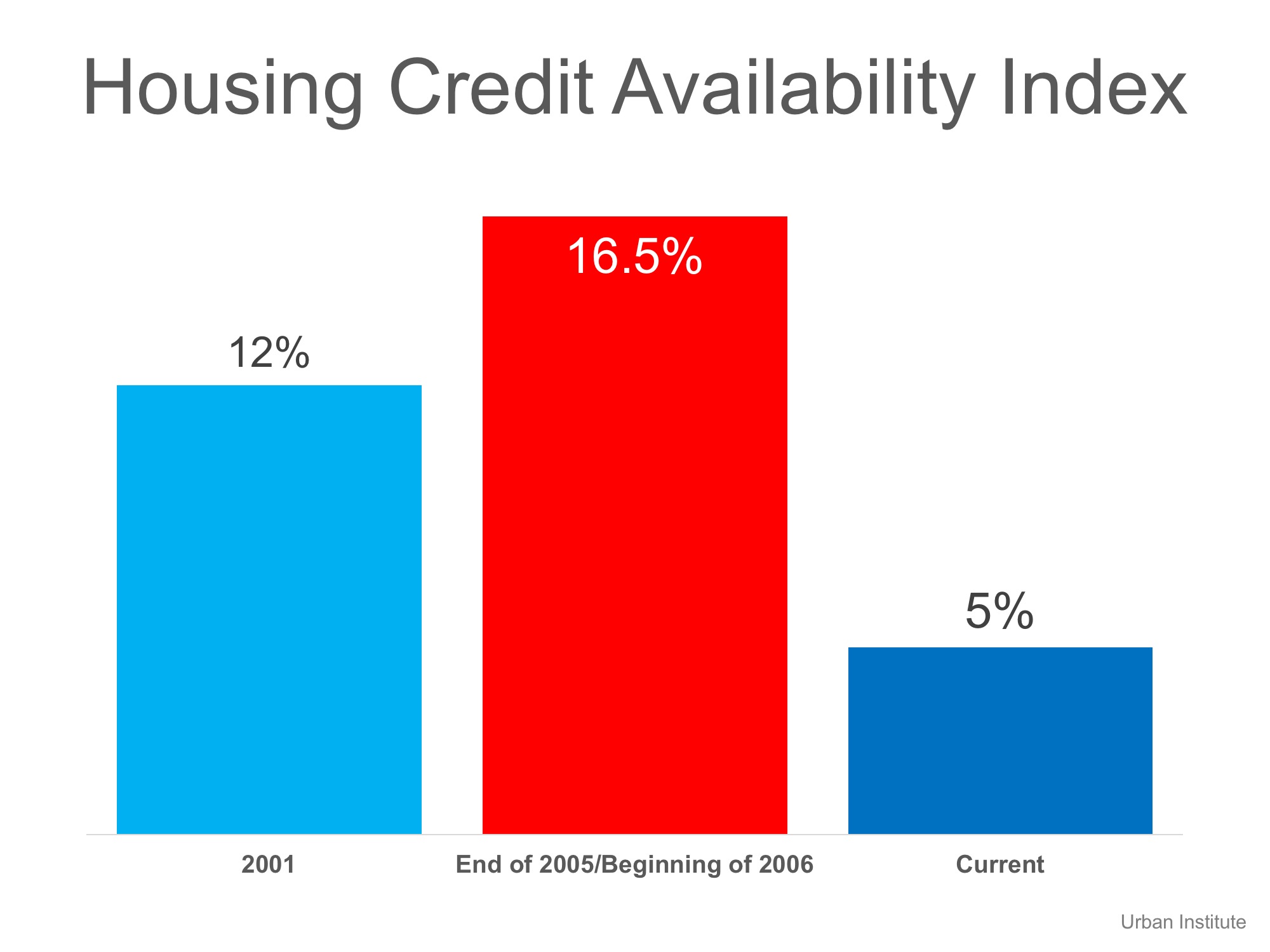
The Urban Institute also publishes a Home Credit Availability Index (HCAI). According to the Institute, the HCAI:
“Measures the percentage of home purchase loans that are likely to default—that is, go unpaid for more than 90 days past their due date. A lower HCAI indicates that lenders are unwilling to tolerate defaults and are imposing tighter lending standards, making it harder to get a loan. A higher HCAI indicates … it is easier to get a loan.”
Here is a graph showing their findings:
Bubble Alert! Is it Getting Too Easy to Get a Mortgage? | MyKCM
Again, today’s lending standards are nowhere near the levels of the boom years. As a matter of fact, they are more stringent than they were even before the boom.

Bottom Line

It is getting easier to gain financing for a home purchase. However, we are not seeing the irresponsible lending that caused the housing crisis.

Wednesday, January 3, 2018

Historically low interest rates are expected to go up in 2018. Don't put off your purchase much longer!


Mortgage Interest Rates Are Going Up… Should I Wait to Buy?


Mortgage interest rates, as reported by Freddie Mac, have increased over the last several weeksFreddie Mac, along with Fannie Mae, the Mortgage Bankers Association and the National Association of Realtors, is calling for mortgage rates to continue to rise over the next four quarters.
This has caused some purchasers to lament the fact that they may no longer be able to get a rate below 3.5%. However, we must realize that current rates are still at historic lows.
Here is a chart showing the average mortgage interest rate over the last several decades:
Mortgage Interest Rates Are Going Up… Should I Wait to Buy? | MyKCM

Bottom Line

Though you may have missed getting the lowest mortgage rate ever offered, you can still get a better interest rate than your older brother or sister did ten years ago, a lower rate than your parents did twenty years ago, and a better rate than your grandparents did forty years ago.

Wednesday, December 27, 2017

More Veterans are taking advantage of the VA home loan program than ever before. Veterans - I can help you with your purchase!


Veterans Affairs Loans by the Numbers [INFOGRAPHIC]


Veterans Affairs Loans by the Numbers [INFOGRAPHIC] | MyKCM

Some Highlights:

  • Since the creation of the VA Home Loans Program, 22 million veterans have been able to achieve the American Dream of homeownership.
  • So far in 2017, $188 billion has been loaned to veterans and their families through the program.
  • VA Purchase Loans are on the rise in 46 out of 50 states and Washington, DC.

Wednesday, December 20, 2017

Waiting too long to buy a home in 2018 WILL cost you money...


What is the Cost of Waiting Until Next Year to Buy?


What is the Cost of Waiting Until Next Year to Buy? | MyKCM
We recently shared that over the course of the last 12 months, home prices have appreciated by 7.0%. Over the same amount of time, interest rates have remained historically low which has allowed many buyers to enter the market.
As a seller, you will likely be most concerned about ‘short-term price’ – where home values are headed over the next six months. As a buyer, however, you must not be concerned about price, but instead about the ‘long-term cost’ of the home.
The Mortgage Bankers Association (MBA), Freddie Mac, and Fannie Mae all project that mortgage interest rates will increase by this time next year. According to CoreLogic’s most recent Home Price Index Report, home prices will appreciate by 4.7% over the next 12 months.

What Does This Mean as a Buyer?

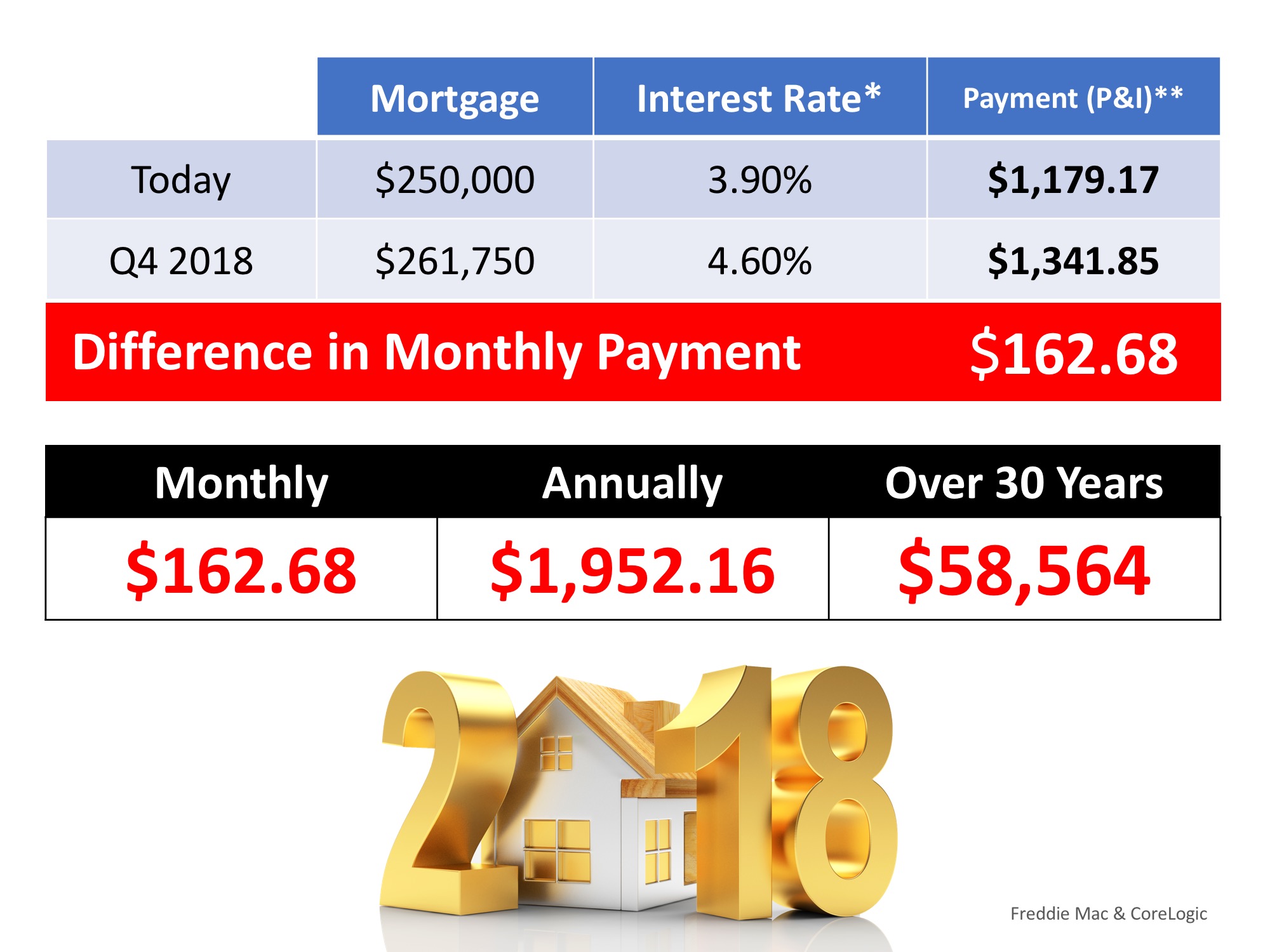
If home prices appreciate by 4.7% over the next twelve months as predicted by CoreLogic, here is a simple demonstration of the impact that an increase in interest rate would have on the mortgage payment of a home selling for approximately $250,000 today:

Bottom Line

If buying a home is in your plan for 2018, doing it sooner rather than later could save you thousands of dollars over the terms of your loan.

Friday, December 8, 2017

The home buying process can be intimidating, especially the mortgage. As long as you have some guidance, everything will be great!

Don't Let Fear Stop You from Applying for a Mortgage

Don't Let Fear Stop You from Applying for a Mortgage | MyKCM
A considerable number of potential buyers shy away from jumping into the real estate market due to their uncertainty about the buying process. A specific cause for concern tends to be mortgage qualification.

For many, the mortgage process can be scary, but it doesn’t have to be!

In order to qualify in today’s market, you’ll need to have saved for a down payment (73% of all buyers made a down payment of less than 20%, with many buyers putting down 3% or less), a stable income and good credit history.
Throughout the entire home buying process, you will interact with many different professionals, all of whom perform necessary roles. These professionals are also valuable resources for you.
Once you’re ready to apply, here are 5 easy steps that Freddie Mac suggests you follow:
  1. Find out your current credit history & score – even if you don’t have perfect credit, you may already qualify for a loan. The average FICO® Score of all closed loans in September was 724, according to Ellie Mae.
  2. Start gathering all your documentation – income verification (such as W-2 forms or tax returns), credit history, and assets (such as bank statements to verify your savings).
  3. Contact a professional – your real estate agent will be able to recommend a loan officer that can help you develop a spending plan, as well as determine how much home you can afford.
  4. Consult with your lender – he or she will review your income, expenses, and financial goals to determine the type and amount of mortgage you qualify for.
  5. Talk to your lender about pre-approval – a pre-approval letter provides an estimate of what you might be able to borrow (provided your financial status doesn’t change), and demonstrates to home sellers that you are serious about buying!

Bottom Line

Do your research, reach out to professionals, stick to your budget, and be sure that you are ready to take on the financial responsibilities of becoming a homeowner.

Wednesday, December 6, 2017

61% of Millennial first-time home buyers are putting down 6% or less...

Millennials Flock Towards Low Down Payment Programs

Millennials Flock Towards Low Down Payment Programs | MyKCM
report released by Down Payment Resource shows that 61% of first-time homebuyers purchased their homes with a down payment of 6% or less.
The trend continued among all buyers with a mortgage, as 73% made a down payment of less than 20%.
An article by Chase points to a new wave of millennial homebuyers:
“We teamed up with Google to help us better understand what customers are searching for and how the home buying landscape is evolving. We found that millennials and first-time homebuyers are making a big splash in the market, and affordability remains top of mind.”
Among millennials who purchased homes, David Norris, Loan Depot’s Head of Retail Lending, said:
“It’s clear from the survey results that Millennials have a lot of anxiety built up about the home buying process.
There is good news, however, as there’s more flexibility than most Millennials think regarding how to qualify for a loan and what’s needed for a down payment.”

Bottom Line

If you are one of the many millennials who is debating a home purchase this year, let’s get together to help you understand your options and set you on the path to preapproval.

Monday, November 20, 2017

Financial expert, David Bach, is encouraging Millennials to buy homes now, over renting.


Millionaire to Millennials: Buy a Home Now!


Millionaire to Millennials: Buy a Home Now! | MyKCM
In a CNBC article, self-made millionaire David Bach explained that “the single biggest mistake millennials are making” is not purchasing a home because buying real estate is “an escalator to wealth.”
Bach went on to explain:
“If millennials don’t buy a home, their chances of actually having any wealth in this country are little to none. The average homeowner to this day is 38 times wealthier than a renter.”
In his bestselling book, “The Automatic Millionaire,” Bach does the math:
“As a renter, you can easily spend half a million dollars or more on rent over the years ($1,500 a month for 30 years comes to $540,000), and in the end wind up just where you started — owning nothing. Or you can buy a house and spend the same amount paying down a mortgage, and in the end wind up owning your own home free and clear!”

Who is David Bach?

Bach is a self-made millionaire who has written nine consecutive New York Times bestsellers. His book, “The Automatic Millionaire,” spent 31 weeks on the New York Times bestseller list. He is one of the only business authors in history to have four books simultaneously on the New York Times, Wall Street Journal, BusinessWeek and USA Today bestseller lists.
He has been a contributor to NBC’s Today Show, appearing more than 100 times, as well as a regular on ABC, CBS, Fox, CNBC, CNN, Yahoo, The View, and PBS. He has also been profiled in many major publications, including the New York Times, BusinessWeek, USA Today, People, Reader’s Digest, Time, Financial TimesWashington Post, the Wall Street Journal, Working Woman, Glamour, Family Circle, Redbook, Huffington Post, Business Insider, Investors’ Business Daily, and Forbes.

Bottom Line

Whenever a well-respected millionaire gives investment advice, people usually clamor to hear it. This millionaire gave simple advice – if you don’t yet live in your own home, go buy one.

Thursday, November 16, 2017

Is a lack of downpayment holding you back from buying a home? With a good credit score, you don't need 20% down to buy.

No… You Do Not Need 20% Down to Buy NOW!

No… You Do Not Need 20% Down to Buy NOW! | MyKCM
The Aspiring Home Buyers Profile from the National Association of Realtors (NAR) found that the American public is still somewhat confused about what is required to qualify for a home mortgage loan in today’s housing market. The results of the survey show that non-homeowners cite the main reason for not currently owning a home, as not being able to afford one.
This brings us to two major misconceptions that we want to address today.

1. Down Payment

NAR’s survey revealed that consumers overestimate the down payment funds needed to qualify for a home loan. According to the report, 39% of non-homeowners say they believe they need more than 20% for a down payment on a home purchase. In actuality, there are many loans written with a down payment of 3% or less.
Many renters may actually be able to enter the housing market sooner than they ever imagined with new programs that have emerged allowing less cash out of pocket.

2. FICO® Scores

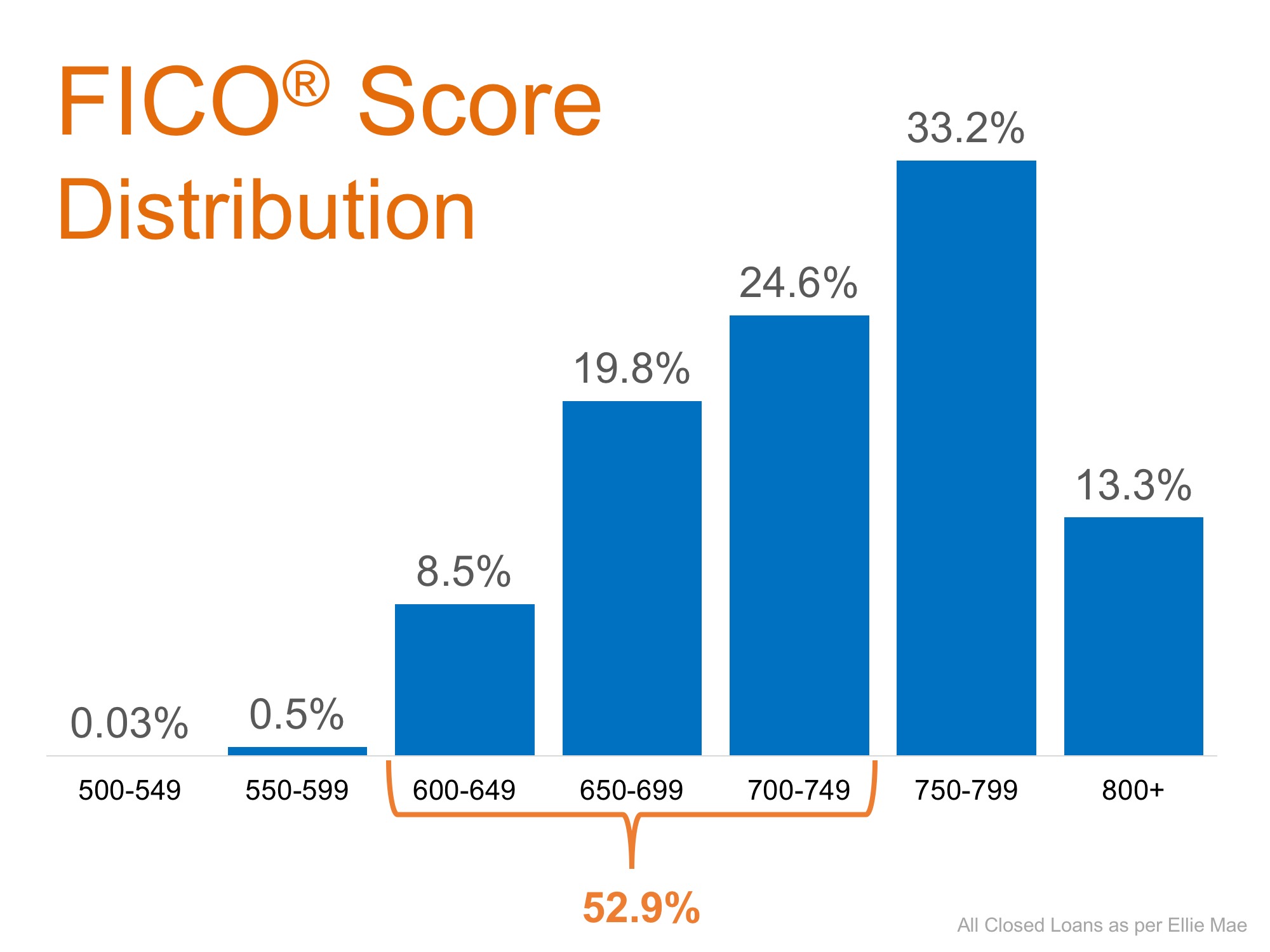
An Ipson survey revealed that 62% of respondents believe they need excellent credit to buy a home, with 43% thinking a “good credit score” is over 780. In actuality, the average FICO® scores of approved conventional and FHA mortgages are much lower.
The average conventional loan closed in August had a credit score of 752, while FHA mortgages closed with a score of 683. The average across all loans closed in August was 724. The chart below shows the distribution of FICO® Scores for all loans approved in August.
No… You Do Not Need 20% Down to Buy NOW! | MyKCM

Bottom Line

If you are a prospective buyer who is ‘ready’ and ‘willing’ to act now, but are not sure if you are ‘able’ to, let’s sit down to help you understand your true options.

Wednesday, November 15, 2017

Do you know the steps in a mortgage process?

The Mortgage Process: What You Need to Know [INFOGRAPHIC]

The Mortgage Process: What You Need to Know [INFOGRAPHIC] | MyKCM

Some Highlights:

  • Many buyers are purchasing a home with a down payment as little as 3%.
  • You may already qualify for a loan, even if you don't have perfect credit.
  • Take advantage of the knowledge of your local professionals who are there to help you determine how much you can afford.